Voices from the Sylff Community
Apr 30, 2026
Bringing to Light an Unknown Seminar by Jacques Derrida
Achilleas Panagiotakis (National and Kapodistrian University of Athens, 2019) used an SRG award to examine the original texts of an overlooked seminar by Jacques Derrida, revealing a crucial but unfinished chapter in the philosopher’s reflections on literature and law.
* * *
In a lecture delivered in Brussels in 1979, Jacques Derrida (1930–2004)—one of the most influential thinkers of the twentieth century—casually mentioned a project he hoped to undertake to explore the relationship between literature and law.
“The analysis I am venturing,” he told his audience, “sticks to the border of a work—which I only project—on law and literature.”[1] Papers and seminars from the same period refer to the work of the writer and literary theorist Maurice Blanchot, suggesting that Derrida was actively engaged with this line of inquiry. This project, though—provisionally entitled Du droit à la littérature—was never completed.
Instead, Derrida went on to publish the better-known Du droit à la philosophie (Right to Philosophy) in 1990.[2] What, then, became of his earlier reflections on literature and law? Were they abandoned, or did they take another form?
To answer this question, I turned to an overlooked source: an unedited, unpublished, and untranslated seminar taught by Derrida at Yale University in 1978–79, also entitled Du droit à la littérature. Despite Derrida’s enormous influence on literary studies, this seminar has received surprisingly little attention. Yet it offers a rare and detailed glimpse into a pivotal moment in his thinking.
The Seminar and the Archive
Beginning in 1975, Derrida taught annually in the United States as a visiting professor, first at Yale University and later, from 1986, at the University of California, Irvine—thanks to the initiative of J. Hillis Miller and Paul de Man.[3] The original French texts of these lectures, along with manuscripts, typescripts, recordings, photographs, and other materials dating from 1946 to 2002, comprise the Jacques Derrida Papers, now held at the Critical Theory Archive of the Special Collections and Archives of the UC Irvine Libraries. Derrida himself actively participated in building this archive by regularly
sending his papers there.
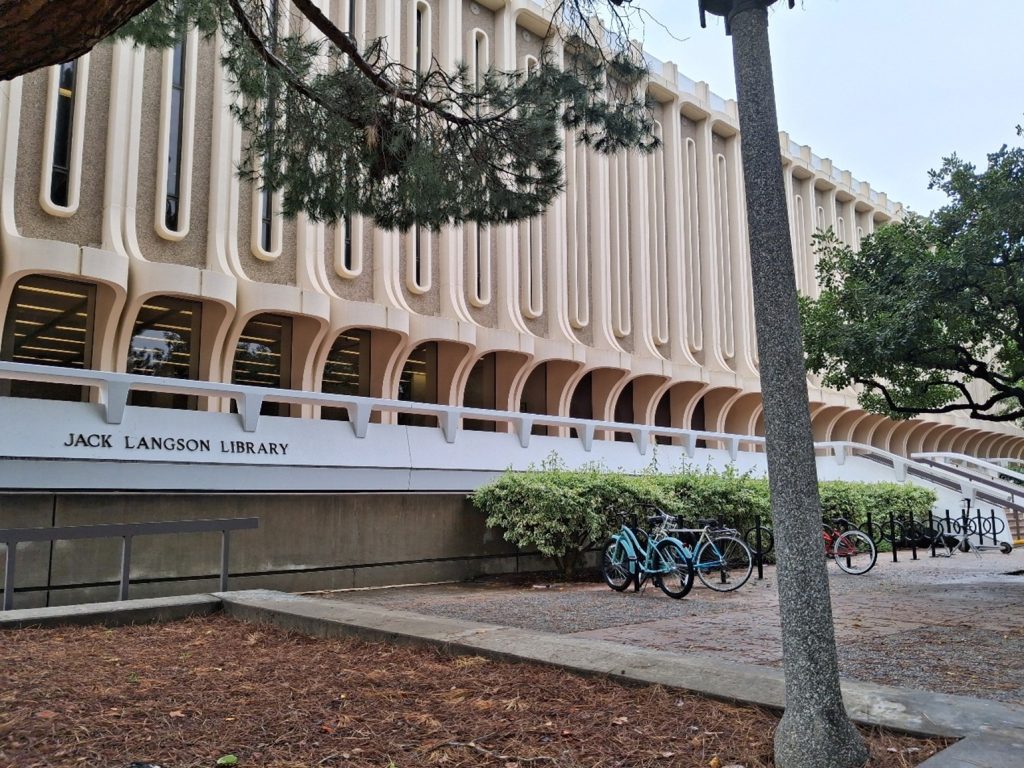
The Langson Library at the University of California, Irvine.
Copies of these lectures also exist at the Institut Mémoires de l’Édition Contemporaine in Caen, France, and digital copies are available through Princeton University Library’s online repository of Derrida’s seminars. Several of Derrida’s seminars have been edited and published in French since 2006, first by Éditions Galilée and later by Éditions du Seuil, as part of the Bibliothèque Derrida.[4] English translations are also underway, though at a slower pace, as part of the Derrida Seminar Translation Project.[5] Du droit à la littérature, however, has not been published in either language.
SRG Fieldwork at UC Irvine
In February 2026, thanks to a Sylff Research Grant, I was able to visit the Langson Library at UC Irvine and examine the Du droit à la littérature materials in person. This proved invaluable for my project. The seminar consists of six lectures—five typewritten and one handwritten and incomplete—preserved in the form of the original typescripts along with two copies. Different handwritten notes, additions, and corrections were found in the margins of all three versions. The folders of the seminar also included short notes on 44 numbered index cards and other supporting materials, such as the main points of discussion for one of the lectures. Additional related materials were found
outside the seminar’s folders.
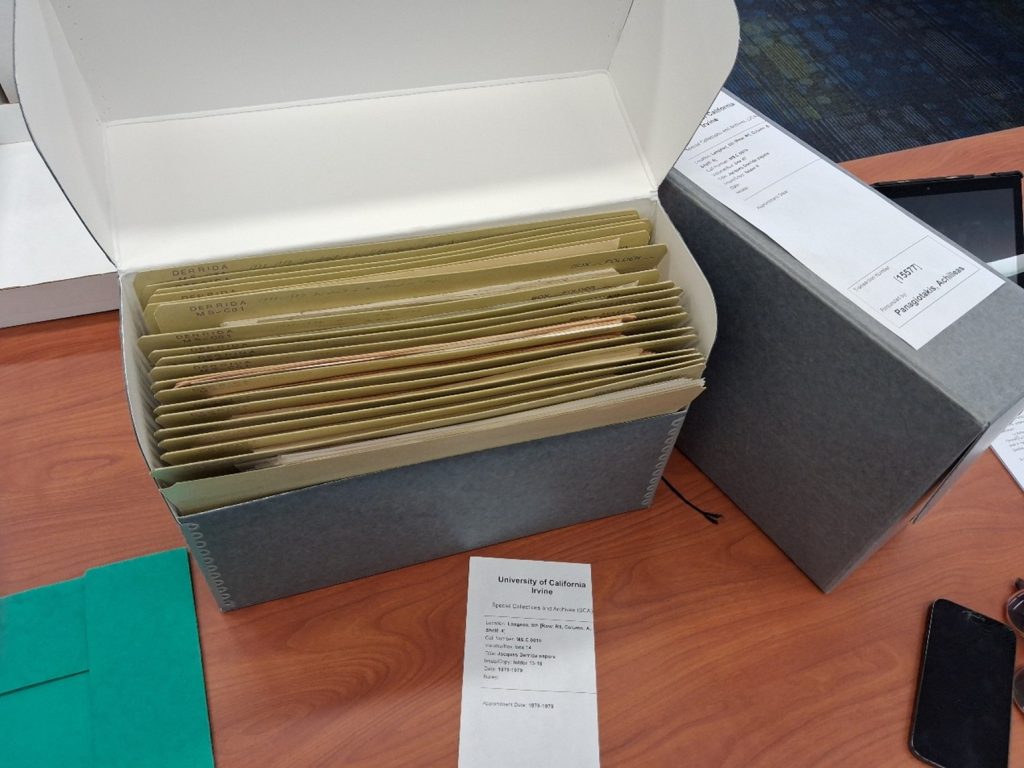
Folders from the Jacques Derrida Papers.
More than half of these materials have not yet been digitized. Working directly with the physical documents made it possible to compare versions carefully, resolve ambiguity issues common in archival research, and decipher Derrida’s notoriously difficult handwriting—tasks that would have been nearly impossible using digital copies alone. By carefully collating the three available versions and supplementary notes, I was able to produce a complete, coherent transcription and edited text of the seminar.
What Du droit à la littérature Argues
Du droit à la littérature is an in-depth study of how institutions—notably copyright laws and universities—have historically shaped literature in the West, from antiquity to the postwar era, with a focus on French texts.
Literature, Derrida argues, is caught in a double bind since literary works can be identified as such only through such legal markers as copyright and genre. At the same time, what gives literature its unique character is its capacity to test and “play” with those very rules. In other words, literature depends on legal definitions to exist, yet it continually pushes against the limits of such definitions.
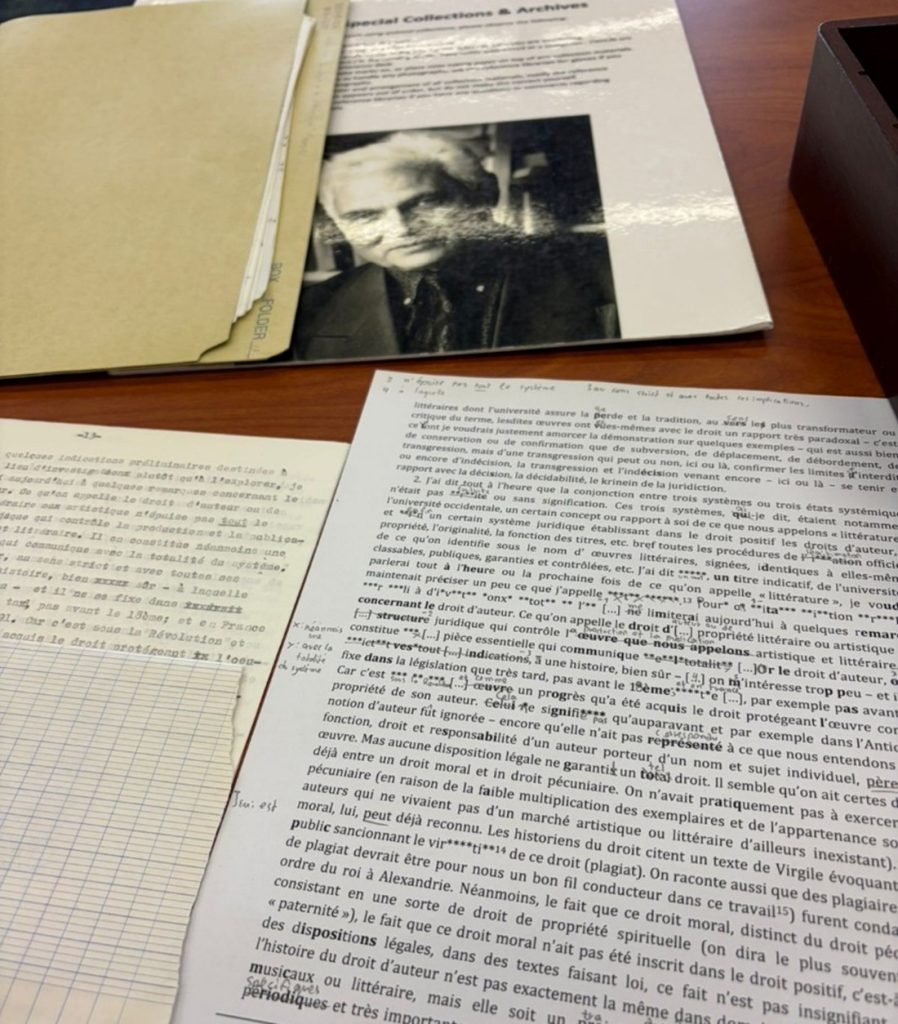
Pages from Du droit à la littérature.
Derrida develops this argument by examining the history of the establishment of authors’ rights over their published work, focusing on the criteria the copyright law uses to identify a printed text as a literary work, such as the author’s name, the existence of a title, and its classification under a genre. He shows how the shift from printers’ monopolies to authors’ rights in late eighteenth-century France coincided with a parallel autonomization of literature and the gradual narrowing of the meaning and use of the word “literature.” Derrida argues that these developments created the conditions for a literary style that plays with the legal conventions that allow a literary text to be acknowledged as such. Circular narratives, titles with multiple meanings, and dense intertextuality are among the strategies he highlights.
The theoretical discussion is complemented by an illustrative reading of Maurice Blanchot’s La Folie du jour (1973). However, Derrida concludes that a literary text can never fully transcend the limits defined by law without becoming unreadable. Literature may transgress the rules that define it, but it must also remain bound to them. The law is thus not simply an external constraint but one of the conditions that makes literature possible.
Why This Seminar Matters Now
The surviving materials from the seminar on Du droit à la littérature allow us to reconstruct the basic contours of Derrida’s abandoned project on law and literature and to better understand the internal connections among his writings of the 1970s. They also preserve a unique discussion on the relationship between literature, the university, and copyright law—themes that are prominent in his published works but were never treated together in any single publication.
This interdisciplinary approach makes a unique contribution by bridging legal studies, history, and literary studies and emphasizing the legal, institutional, and social dimensions of literature. Finally, Derrida’s historically grounded approach in this seminar is in itself an indirect challenge to the longstanding accusation that deconstruction is indifferent to historical context.
Scholarly Encounters
During my stay in California, I had the opportunity to meet and have a long discussion with Peggy Kamuf, professor emerita at the University of Southern California and one of the foremost experts on Derrida’s work. Named by Derrida himself as co-designate (alongside Emory University Professor Geoffrey Bennington) of the Derrida Estate, she currently directs the Derrida Seminars Translation Project and has co-edited a number
of Derrida’s seminars in English.
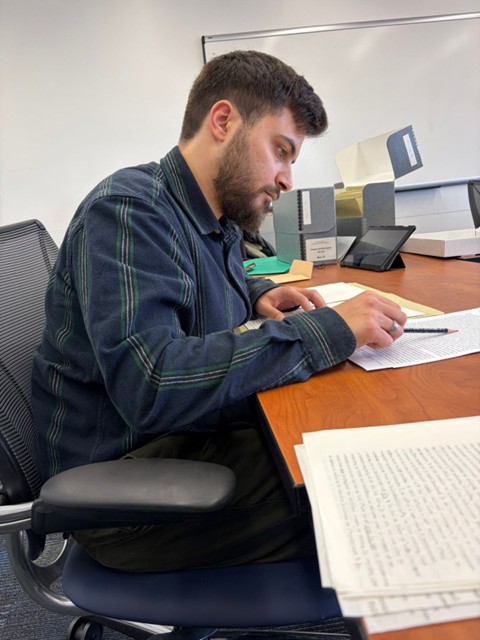
Working inside the Caroline A. Laudati Conference Room, Langson Library, UC Irvine.
Our discussion provided invaluable insights into the constitution and history of the UC Irvine archive, Derrida’s seminars in the United States, and the evolution of his thought. I was also informed of the ongoing publishing and translation efforts surrounding these seminars both in France and the United States. Our meeting was a vital part of my project, and I am grateful for her generosity and guidance.
I am also grateful to the Sylff program for making this research project possible by providing funding for the transatlantic trip from Greece to the United States. Thanks to the SRG award, the central phase of the project has now been completed. The next step will be to share my findings with the wider academic community, in accordance with the wishes of the Derrida Estate.
Notes
[1] Jacques Derrida, “Title (To Be Specified),” trans. Tom Conley, SubStance 10, no. 2, issue 31 (1981): 12.
[2] Translated into English by Jan Plug in two volumes: Who’s Afraid of Philosophy? Right to Philosophy 1 (Stanford: Stanford University Press, 2002); and Eyes of the University: Right to Philosophy 2 (Stanford: Stanford University Press, 2004).
[3] See Benoît Peeters, Derrida: A Biography, trans. Andrew Brown (Cambridge: Polity Press, 2013), 271–72; Marc Redfield, Theory at Yale: The Strange Case of Deconstruction in America (New York: Fordham University Press, 2016), 26.
[4] A list of all published seminars in the Bibliothèque Derrida can be found here. For additional information on the transition from Éditions Galilée to Éditions du Seuil, see Nathalie Weill, “Derrida de Galilée au Seuil: les raisons d’un transfert,” Le Monde, July 7, 2019, https://www.lemonde.fr/livres/article/2019/07/07/derrida-de-galilee-au-seuil-les-raisons-d-un-transfert_5486439_3260.html.
[5] Additional information on the Derrida Seminars Translation Project can be found here.