Voices from the Sylff Community
Jul 17, 2026
Observations on Wealth and Giving in Japan: Notes from a Personal Study Visit
Japan’s culture of giving remains understated, even as the country ranks among the world’s wealthiest nations. Drawing on a personal visit, Lawrence Jackson (UNSW Business School, 1997) explores its distinctive forms and the potential for growth and change.
Introduction
While undertaking my executive MBA degree at the Australian Graduate School of Management at the University of New South Wales, I was fortunate to receive a generous scholarship from the Ryoichi Sasakawa Young Leaders Fellowship Fund of Japan in 1997. Sylff’s support enabled me to complete my studies and take part in an international exchange in nonprofit management at the Kellogg Graduate School of Management at Northwestern University. That experience proved pivotal for my future career in the nonprofit sector and continues to shape my work today as a consultant in the philanthropic sector, specializing in higher education, medical research, healthcare, and the arts.
I remain deeply grateful for the Sylff fellowship. This investment in my education not only opened doors professionally but also instilled in me a lasting sense of responsibility to reflect on the intersection of wealth, social impact, and philanthropy. That sense of gratitude has shaped my ongoing perspective and was very much on my mind during a recent study visit to Japan focused on philanthropy, where I observed how the country’s economic power sits alongside a more understated culture of giving.
Japan’s Wealth and Global Standing
Japan today is one of the wealthiest nations in the world. According to the UBS Global Wealth Report, the average adult holds around US$205,000 in assets, with a median of US$102,000. More than 2.7 million Japanese adults are now US-dollar millionaires, and about 40 billionaires sit at the very top of the wealth pyramid.
Forbes’ Japan’s 50 Richest 2025 list brings these figures to life. Tadashi Yanai, founder of Fast Retailing and the driving force behind Uniqlo, sits at the top with nearly US$50 billion. He is followed by Masayoshi Son of SoftBank with more than US$28 billion, and Takemitsu Takizaki, founder of Keyence, whose fortune is estimated at more than US$20 billion. Collectively, Japan’s top 50 billionaires hold more than US$228 billion in assets across retail, technology, real estate, finance, and consumer industries.
When compared to other advanced economies, Japan’s private wealth is impressive. On a per capita basis, Japanese households are wealthier than those in Germany, Italy, or South Korea, and sit somewhat behind Canada and the United Kingdom, and well behind Australia, which consistently ranks among the very top countries globally on both average and median household wealth.
The Giving Gap
What struck me most on the study mission was not the presence of wealth but the absence of a visible culture of large-scale philanthropy. The Charities Aid Foundation’s World Giving Index 2024 ranks Japan 127th out of 142 countries, far behind the United States, Canada, the United Kingdom, Australia, and much of Europe.
In these countries, philanthropy has matured into a visible social force. Structured family foundations, institutional endowments, and the culture of “mega-giving” have become common features of public life. Large gifts to universities, hospitals, and cultural institutions are seen as natural extensions of personal and family legacy.
By contrast, in Japan I did not see the same level of prominent major donor name recognition on public institutions such as museums, galleries, arts companies, hospitals, or universities, at least not in the way one would expect in Western countries and especially in the United States. What I did notice, however, were deeply rooted local traditions of corporate, individual, communal, and small-business giving, often expressed in cultural and spiritual settings.
At the highly iconic Fushimi Inari Taisha, a major Shinto shrine in Kyoto, the names of countless individual donors are inscribed on the reverse side of the famous vermilion torii gates, creating a forest of giving that stretches up the mountainside. Similarly, at the Yasaka Shrine in Kyoto’s Gion district, hundreds of lanterns hang in front of the main stage, each carrying the name of a local sponsor or supporter. These displays, while different in form from Western philanthropic naming practices, represent a long-standing and highly visible culture of community-based giving.
Alongside these manifestations, Japan’s modern philanthropy remains quieter, less visible, and often corporate in nature. Major companies continue to play a significant role in supporting social initiatives, while large institutional foundations such as the Nippon Foundation and the Tokyo Foundation provide hundreds of millions of dollars annually to support education, research, and humanitarian causes. Community giving also happens informally through neighborhood associations and mutual aid groups.
Still, there are moments when Japanese philanthropy has operated at a global scale. Yanai’s US$300 million endowment to the UCLA Anderson School of Management in 2024 is one of the largest single gifts by any Japanese donor. Masayoshi Son’s ¥10 billion donation following the 2011 Tohoku earthquake (approximately US$125 million at 2011 exchange rates) was transformative in supporting recovery efforts. These examples demonstrate capacity, but they remain the exception rather than the norm.
A Global Landscape of Giving
When we step back and look at the global landscape, it becomes even clearer how Japan stands apart.
In North America, philanthropy is embedded in culture. US billionaires routinely pledge sums in the hundreds of millions, often through structured foundations that operate with professional staff and global ambitions. Canada has followed a similar trajectory, with family foundations taking on increasingly important roles in education, health, and culture.
Australia has seen rapid growth in private ancillary funds over the past two decades, embedding philanthropy into financial planning for wealthy families. In the United Kingdom and across much of Europe, quieter traditions of philanthropy—often more understated than in the United States—still account for billions in annual giving through foundations and endowed institutions.
Philanthropy is also expanding rapidly beyond the Western world. In Israel, it is shaped by strong community and diaspora linkages, with local giving often amplified by global Jewish networks. In the Gulf states, sovereign wealth and family fortunes are being increasingly channeled into education, healthcare, and humanitarian initiatives. In Asia, China has produced a generation of new mega-donors, many from the technology sector, who are beginning to launch foundations on a global scale. Singapore has positioned itself as a regional hub for philanthropy, supported by favorable regulation and cross-border networks. India, with its deep cultural traditions of giving, is now home to global-scale philanthropists funding education, digital access, and equity initiatives.
Against this backdrop, Japan’s low level of visible individual philanthropy stands out sharply.
Building Infrastructure for Change
What I also learned on this study visit is that change is possible—and already underway. Several institutions are laying the groundwork for a more professional and transparent philanthropic sector in Japan.
The Japan Fundraising Association publishes the annual Giving Japan report, the country’s most reliable source on donation trends. The Japan Philanthropic Association promotes both corporate and individual giving and runs education programs to encourage philanthropic practice. The Japan Foundation Center provides a hub for grant-making foundations and offers data to increase transparency.
These institutions are important not only for gathering information but also for shaping a professional culture around fundraising, donor stewardship, and social impact measurement. They represent the beginnings of an infrastructure that could support a more expansive and sustainable culture of giving in Japan.
What Japan Can Learn
Reflecting on this experience, three lessons seem particularly important.
First, visibility matters. High-profile gifts inspire others. Countries with a culture of mega-giving tend to develop a virtuous cycle in which public generosity sets an example and normalizes philanthropy among peers.
Second, structures drive sustainability. Private foundations, endowments, and ancillary funds are not just vehicles for giving; they are frameworks that make giving consistent, accountable, and intergenerational.
Third, professionalization makes a difference. Skilled fundraisers, robust governance, and transparent data make philanthropy more credible and impactful. Japan has already begun to build these capacities, but there is still room to grow.
Personal Reflections
For me, this is not just an abstract reflection. I am myself a product of Japanese philanthropy. My Sylff fellowship enabled me to complete my executive MBA and undertake an international exchange that proved pivotal to my career. It was an investment not just in me but in the idea that global learning and cross-cultural exchange can have long-term social value.
That gift demonstrated the profound impact philanthropy can have when it is channeled with vision. It is a reminder that philanthropy is not only about generosity but about shaping opportunity, creating pathways, and connecting people across borders. For that, I remain profoundly grateful.
The Opportunity Ahead
Japan has immense resources, world-leading enterprises, and an emerging generation of globally connected entrepreneurs who are increasingly mindful of social impact. The opportunity is to adapt international best practice while creating a distinctly Japanese model of philanthropy, one that respects cultural traditions of modesty and collectivism while also encouraging greater visibility, scale, and long-term commitment.
If Japan can achieve this, it will not only strengthen its own society but also contribute meaningfully to tackling global challenges, from climate change and aging populations to technological disruption and inequality.
Conclusion
Japan has wealth to rival the West. The question is whether it will match the world in giving.
From my personal journey, assisted by the generosity of the Sylff program, I know the answer can be yes. With scale, visibility, and sustained commitment, Japan can move from being an economic giant to becoming a global leader in twenty-first-century giving.
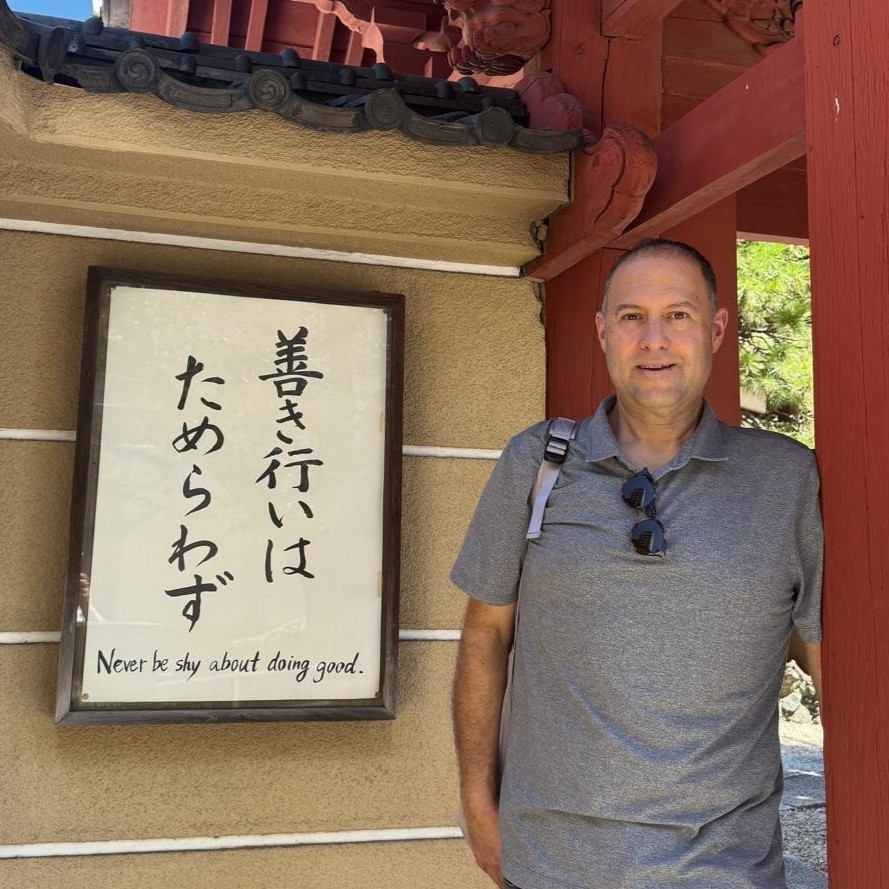
One line I encountered on my visit has stayed with me. At the entrance to the temple Zojo-ji near Tokyo Tower, a simple inscription reads: “Never be shy about doing good.” It felt like the perfect message to carry forward, a reminder that philanthropy, in whatever form it takes, is most powerful when it is shared openly and without hesitation.