Voices from the Sylff Community
Sep 24, 2026
Childbirth Choices in Suriname: Reproductive Traditions and Modern Care
Drawing on interviews with mothers, traditional healers, and healthcare practitioners, Mayra Robles Sumter (University of Oregon, 2025) explores how diverse cultural traditions continue to shape pregnancy, childbirth, and postpartum care in Suriname alongside modern biomedical practices.
* * *
Suriname offers a rich context for investigating the intersection of diverse knowledge systems in reproductive health. Although it is the smallest country in South America, with a population of approximately 612,985, Suriname ranks among the most ethnically and religiously diverse nations in the world. Its population includes Indigenous peoples (4%)—Kali’ña, Lokono, Tareno (Tirio), and Wayana—alongside Hindustani (27%), Afro-Surinamese (36%, comprising Maroons and Creoles), Javanese (13%), Chinese (5%), mixed-race (12%), and other groups (3%) from Europe, the Middle East, and Latin America. This diversity is reflected in the country’s multiethnic communities, plural religious practices, national commemorations, and varied conceptions of health and healing.
Suriname has one of the highest maternal mortality rates in Latin America and the Caribbean, with approximately 130 women dying per 100,000 births. Although stillbirth rates are improving, they remain high at 14 per 1,000 births, compared to the regional average of 13 per 1,000 births (Prüst et al. 2020). Improving maternal and infant health outcomes in Suriname requires not only increased investment in clinical infrastructure but also a broader understanding of how health systems engage with the communities they serve. Recognizing plural interpretations of health and healing is essential for providing culturally sensitive care and addressing the emotional and spiritual needs of families.
These concerns are also reflected in the United Nations Sustainable Development Goals, particularly SDG 3 (Good Health and Well-Being) and SDG 10 (Reduced Inequalities). Defining a “safe” birth environment requires more than clinical standards. It also involves recognizing the “institutional rules and governing bodies, gendered hierarchies shaping women’s experience of care, and the advocacy roles played by traditional midwives” (Gamlin et al. 2020; Reichert 2024).
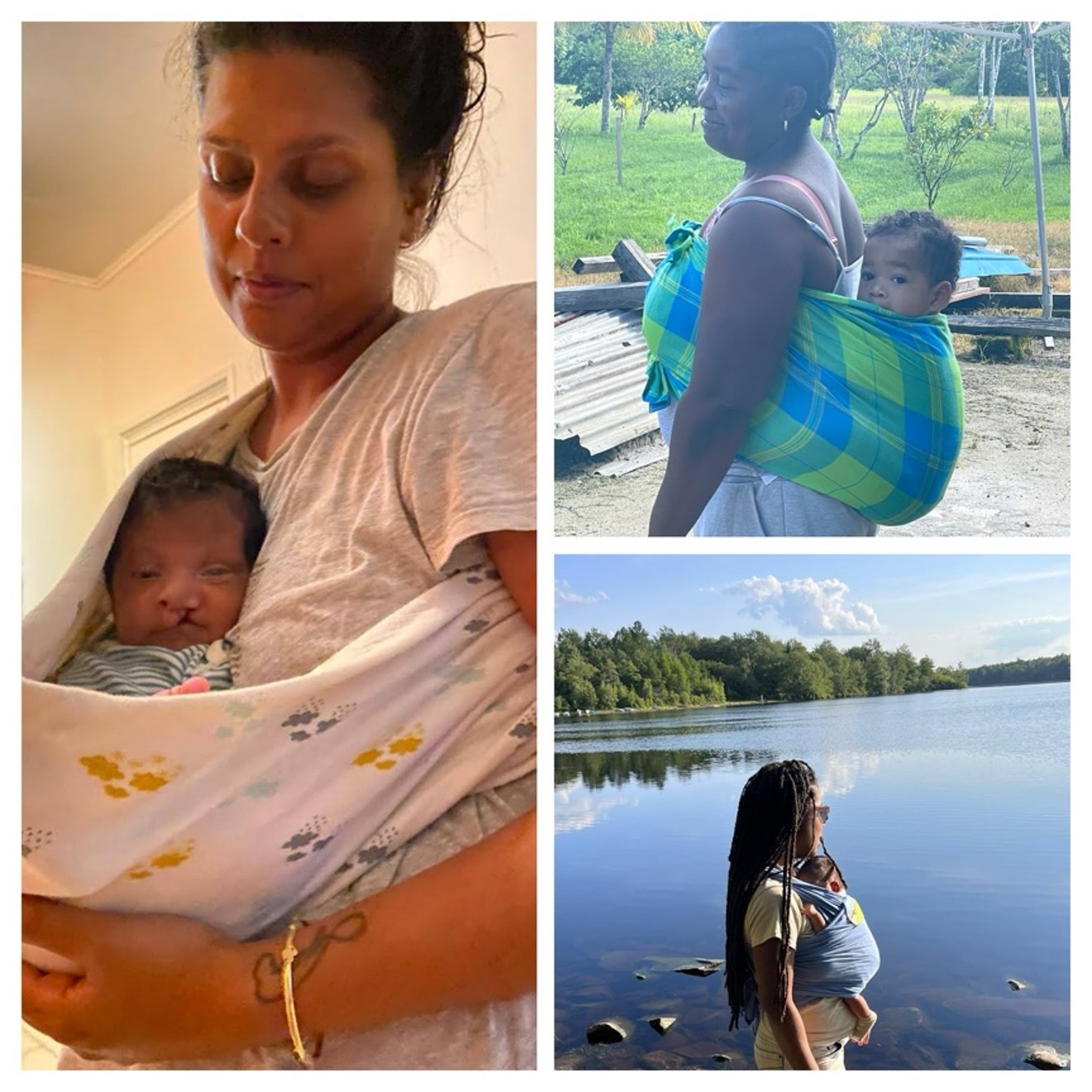
Different baby-carrying practices reflect the diversity of childcare traditions in Suriname.
The research I conducted with the support of a Sylff Research Grant examined cultural practices related to reproductive care in Suriname. Specifically, I studied the ways reproductive pluralism shapes childbirth and perinatal care in the country. I interviewed mothers to better understand how their care experiences highlight the roles of diverse actors in navigating reproductive pluralism.
Listening to Families and Caregivers
I used narrative ethnography (Gubrium and Holstein 2008; Wilson 2008; Datta 2018) as a qualitative research method to explore cultural beliefs and practices surrounding reproductive health. Narrative ethnography uses storytelling, including autoethnography, to understand broader social and cultural meanings through lived experience and personal narratives (Gubrium and Holstein 2008; Datta 2018). This enabled me to examine perceptions of embodiment, personhood, and ancestral knowledge that inform reproductive practices in Suriname.
This approach is particularly valuable in the context of Surinamese pluralism, as much of the existing research on Suriname’s healthcare has not been conducted through the lens of Surinamese storytelling. Through close engagement and participant observation, I sought to highlight the voices of mothers and families as they navigated multiple approaches to reproductive health and care.
This research was conducted in Paramaribo, Brokopondo, Sipaliwini, and Commewijne. In total, I conducted in-depth, open-ended interviews with 25 respondents, including expectant mothers (n = 7), fathers (n = 2), traditional healers (n = 8), healthcare practitioners and licensed midwives (n = 5), a gynecologist and obstetrician (n = 2), and a pharmacist (n = 1). The respondents were recruited through snowball and event-based sampling, and the interviews ranged from 45 minutes to 2 hours.
The respondents were selected from a range of reproductive care facilities including hospitals, traditional health clinics, private clinics, and herbal shops. Three families were selected for extended participatory observation during postpartum events and ongoing open-ended interviews, which also included participation in non-research-related events that helped build trust and relationships.
The data was analyzed using Dedoose, a cloud-based application, through thematic analysis. In total, I collected 114 hours of interviews; these were conducted in several languages, including Sranang Tongo, the country’s widely spoken lingua franca, as well as Dutch and Saamaka, a language spoken by the Saamaka Afro-Surinamese community. In some cases, conversations moved fluidly between multiple languages, such as Javanese, which is spoken among descendants of Indonesian migrants in Suriname, as well as Saamaka, Dutch, and Sranang Tongo. These interviews were subsequently translated into English for analysis.
Traditions of Care and Belonging
The documented practices stand out for their cultural depth and continued relevance to maternal and infant well-being.
A particularly notable example is the Javanese practice of burying the placenta after birth, carried out by the father and a dukun (traditional midwife). The ritual is accompanied by letters written by both parents to the newborn, reflecting a profound ethic of relational care and spiritual continuity between the child, the family, and the earth.
Other rituals mark important stages in a child’s early life. Ceremonies surrounding the falling of the umbilical stump and the child’s thirty-fifth day of life serve as structured milestones of personhood and social reintegration that affirm the child’s place within the community.
The use of vaginal steam baths, practiced widely among Afro-Surinamese women after childbirth, represents an embodied tradition of uterine cleansing and postpartum recovery that has persisted across generations and is increasingly recognized by practitioners as a meaningful complement to clinical postpartum care. The use of medicinal plants and herbal baths, intended to protect infants from evil spirits and strengthen their well-being, further illustrates the richness of Surinamese ethnobiological knowledge.
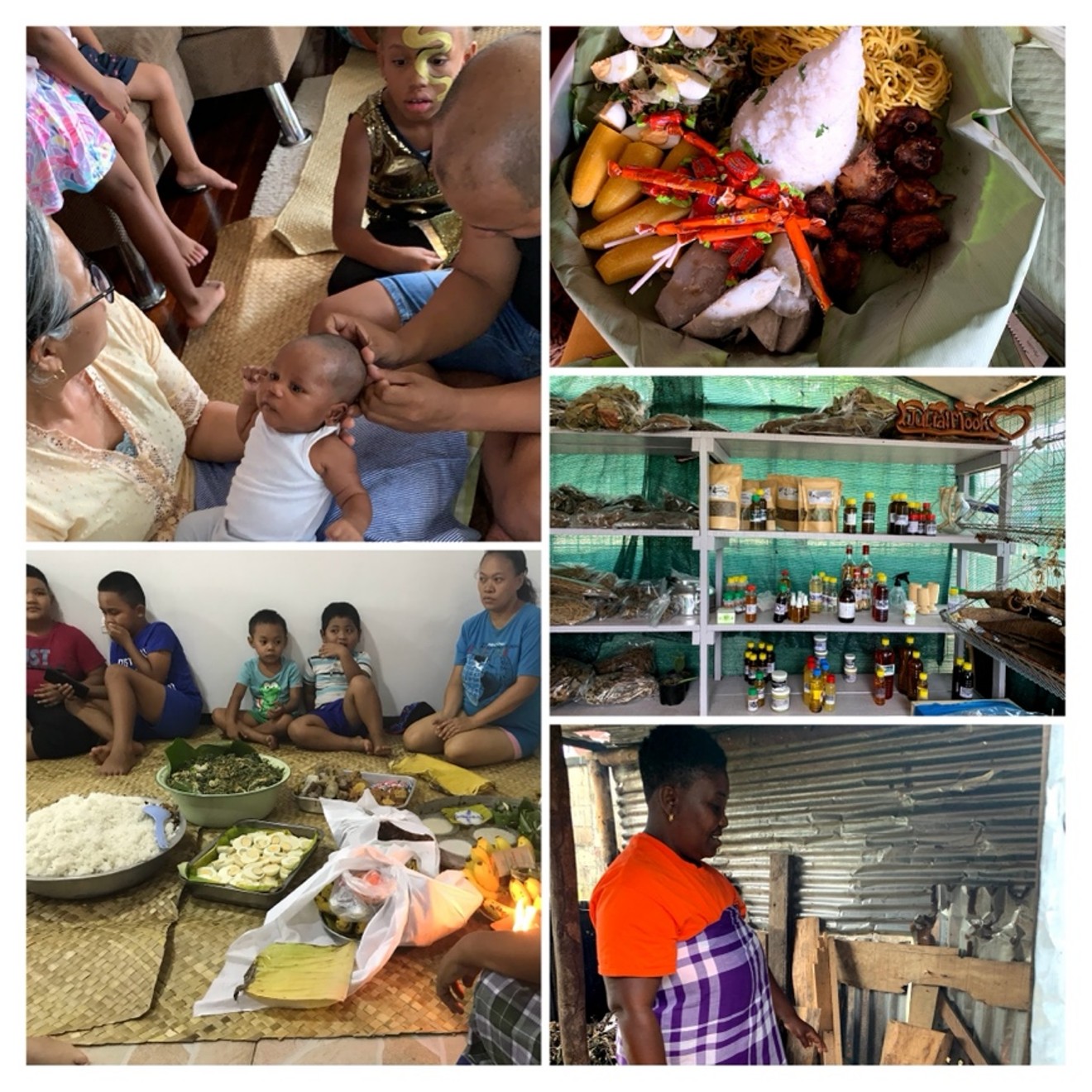
A collage showing Javanese and Afro-Surinamese postpartum events and a shop selling medicinal herbs.
Equally significant is the cultural belief that conflict between parents can affect the health and spiritual vitality of a newborn. This reflects a holistic conception of reproductive health in which emotional, social, spiritual, and physical dimensions of care are deeply interconnected.
These practices, embedded in Javanese, Afro-Surinamese, Hindustani, and Indigenous traditions, are not isolated rituals but coherent systems of knowledge that address the physical, psychological, and relational needs of mothers and infants in ways that biomedicine alone does not fully encompass.
The significance of these findings extends well beyond the borders of Suriname. Suriname is both a Caribbean nation and a South American country, placing it in a unique position from which to understand reproductive pluralism across the broader Latin American and Caribbean region. The urgency of culturally responsive care in Suriname is not merely academic; it is a matter of life and well-being.
Lessons for the Future
Cultural practices related to pregnancy and childbirth are not peripheral to reproductive healthcare in Suriname; they are central to it. Drawing on narrative ethnography and the lived experiences of mothers, families, traditional healers, and birth workers across Suriname’s uniquely pluralistic society, this research shows that ethnomedical knowledge is not a vestige of the past but a living, dynamic system of care that coexists with and actively shapes biomedical practice.
Reproductive pluralism in Suriname is not the exception; it is the norm. The cultural practices documented here, encompassing Javanese, Afro-Surinamese, Hindustani, and Indigenous traditions, represent generations of embodied knowledge about how to bring new life into the world safely, meaningfully, and with dignity.
These practices are not incompatible with biomedical care. Rather, they already coexist with it, shaping and enriching the ways families experience reproductive health. The challenge for health systems in Suriname is to create the institutional conditions in which this coexistence is not merely tolerated but actively supported.
Culturally sensitive reproductive care is not an optional complement to quality healthcare; it is a prerequisite for it. In a region where alternative approaches to reproductive health continue to play an important role, embracing reproductive pluralism may be one of the most effective and humane paths forward.
References
Datta, Ranjan. 2018. “Traditional Storytelling: An Effective Indigenous Research Methodology and Its Implications for Environmental Research.” AlterNative: An International Journal of Indigenous Peoples 14 (1): 35–44. https://doi.org/10.1177/1177180117741351.
Gamlin, Jennie, Sahra Gibbon, Paola M. Sesia, and Lina Berrio, eds. 2020. Critical Medical Anthropology: Perspectives in and from Latin America. UCL Press.
Gubrium, Jaber, and James Holstein. 2008. “Narrative Ethnography.” In Handbook of Emergent Methods.
Prüst, Zita D., Kim J. C. Verschueren, Gieta A. A. Bhikha-Kori, et al. 2020. “Investigation of Stillbirth Causes in Suriname: Application of the WHO ICD-PM Tool to National-Level Hospital Data.” Global Health Action 13 (1): 1794105. https://doi.org/10.1080/16549716.2020.1794105.
Reichert, Alexandra J. 2024. “‘They Study for Six Years. We Study for Generations’: Renegotiating Birth, Power, and Interculturalidad in the Ecuadorian Amazon.” The Journal of Latin American and Caribbean Anthropology 29 (2): 169–78. https://doi.org/10.1111/jlca.12716.
Wilson, Shawn. 2008. Research Is Ceremony: Indigenous Research Methods. Fernwood Publishing.