Voices from the Sylff Community
Mar 10, 2026
Building a Circular Future in Yogyakarta with Community-Driven Waste Solutions
As Indonesia faces a national waste emergency, a grassroots initiative in Yogyakarta is showing how public awareness and community engagement can turn waste from an environmental burden into an economic resource.
* * *
Indonesia is currently facing an unprecedented waste crisis. In response to the escalating situation, the government of Indonesia has officially declared a national waste emergency. According to data released by the Ministry of Environment, national waste generation has reached 143,824 tons per day, a figure that continues to rise along with population growth, shifting consumption patterns, and rapid urbanization.
For decades, Indonesia has relied heavily on landfills—locally called Tempat Pembuangan Akhir (TPA)—as the primary solution for waste disposal. However, this approach has proven unsustainable. Many landfills across the country are now operating beyond capacity, forcing several regions to shut them down entirely. The closure of these facilities has resulted in widespread waste accumulation along roadsides, in residential areas, and at temporary dumping points, often producing strong odors and posing serious health and environmental risks.
In some regions, the response has been disturbingly superficial. Piles of uncollected waste are merely covered with tarpaulins and treated with special odor-reducing liquids, offering only temporary relief and failing to address the core problem. These conditions underscore the urgent need for systemic change in how waste is managed in Indonesia.
Lack of Public Awareness
Rima Amalia Eka Widya, a 2019–20 Sylff fellow at Gadjah Mada University, points out that the current waste emergency did not emerge overnight. Instead, it is the result of long-standing structural issues compounded by limited public understanding of proper and responsible waste management.
“The waste problem in Indonesia has existed for a long time,” Rima explains. “What makes it increasingly unmanageable is the lack of public awareness and knowledge about how to manage waste correctly and wisely, starting from the household level.”
Rima believes that waste is still widely perceived as something to be discarded and forgotten, rather than as a material resource that can be managed, processed, and transformed into economic value. This mindset, she argues, has slowed progress toward sustainable waste solutions and placed an overwhelming burden on downstream facilities, such as landfills and waste processing sites.
CircuLife: Transforming Waste into Opportunity
Motivated by these challenges, Rima initiated a community-based program under Sylff Leadership Initiatives 2025, titled “Community-Driven Waste Management and Circular Economy in Yogyakarta (CircuLife).” The initiative seeks to reframe waste not as a problem but as a potential driver of environmentally friendly local economies.
Through CircuLife, Rima and her team work directly with communities in Yogyakarta to promote practical and accessible waste management practices. The program emphasizes that sustainable waste practices do not require advanced technology or large financial investments. Instead, meaningful change can begin with simple innovations, behavioral shifts, and consistent community engagement.
“Our goal is to show communities that waste can be managed locally and sustainably,” Rima says. “With the right knowledge and continuous assistance, people can transform waste into an economic resource rather than an environmental burden.”
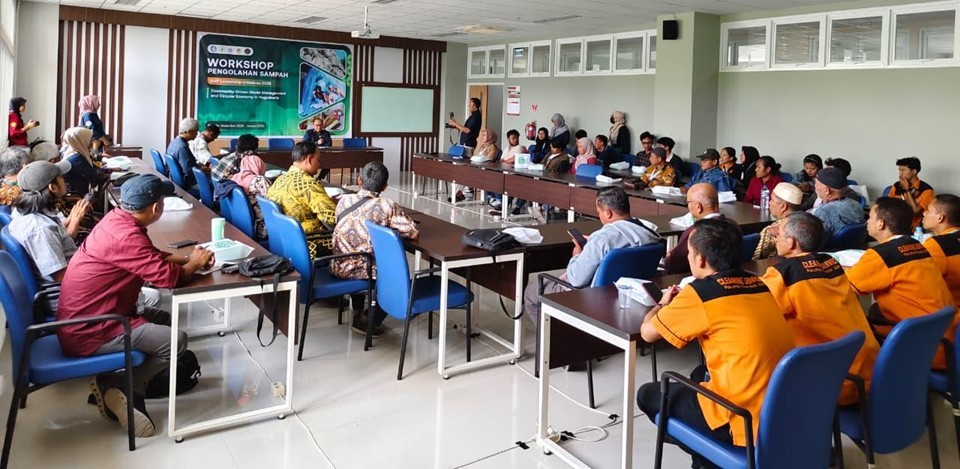
Community members in Yogyakarta participate in the Waste Management Workshop Series, bringing together students, cleaning service workers, environmental activists, residents, waste collection managers, and village government representatives.
A Multi-Stakeholder Approach
One of CircuLife’s defining strengths is its collaborative, multi-stakeholder approach. Recognizing that waste management cannot be addressed by communities alone, Rima actively involves a wide range of partners, including village governments, academics and researchers from Gadjah Mada University, waste banks, managers of temporary waste collecting sites (Tempat Penampungan Sementara, or TPS), innovative environmental startups, national and local media outlets, and environmental activists and community organizers.
By bridging academic knowledge with grassroots practice, CircuLife functions as a platform that connects research-based innovation with real-world application. This collaboration also ensures that local voices and lived experiences inform program design and implementation.
Systemic Weaknesses in Waste Management Practices
The situation at many TPS facilities in Yogyakarta highlights systemic weaknesses in current waste management practices. Most TPS receive waste in mixed form, with organic and inorganic materials combined. This significantly increases the workload for TPS staff, who must manually sort waste before processing.
In some areas, a single TPS serves approximately 700 households and receives more than 2 tons of waste per day. Such volumes are extremely difficult to manage, especially when organic waste dominates the waste stream. As a result, organic waste often accumulates around TPS facilities, creating unsanitary conditions and triggering complaints from nearby residents.
Rima notes that this bottleneck is largely preventable. “If organic waste were managed at the household level, TPS facilities would not be overwhelmed,” she explains. “The problem is not only infrastructure but also behavior and understanding.”
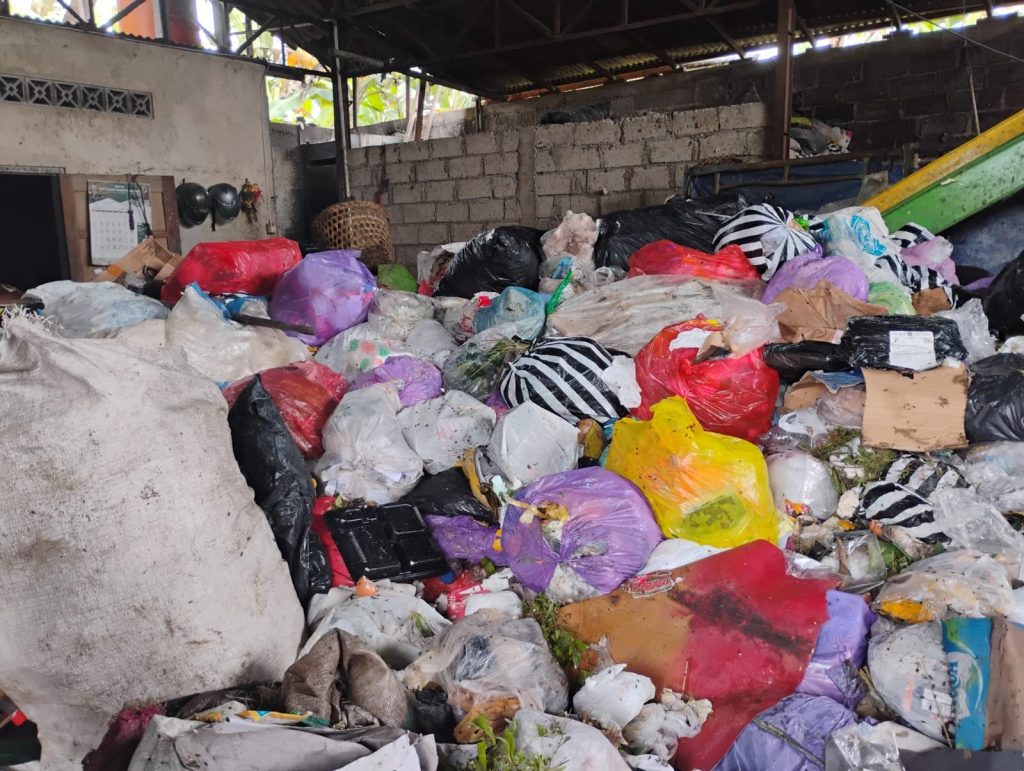
Accumulated waste at a TPS site in Sleman Regency, Yogyakarta, caused by equipment failure and heavy reliance on an incinerator used to dry and burn organic waste.
Empowering Communities through Simple Innovations
Despite the severity of the problem, Rima remains optimistic. She emphasizes that many people are unaware that organic waste can be processed using simple, low-cost methods, such as composting, biopores, or maggot-based systems. These techniques are accessible to households and do not require specialized equipment.
Through workshops, hands-on demonstrations, and continuous mentoring, the CircuLife team introduces these methods to communities and supports them during the adoption process. The focus is not merely on sharing knowledge but also on building confidence and long-term commitment. “People often think waste management is complicated or expensive,” Rima says. “But once they see that it can be done simply and independently, their perspective begins to change.”
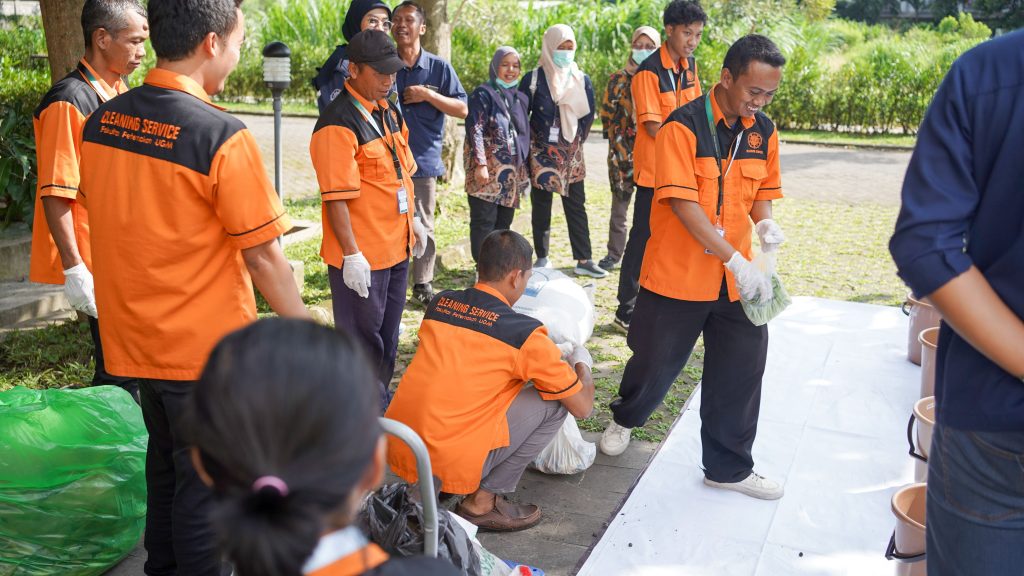
Participants practice making compost from household and livestock organic waste using simple, low-cost methods.
Changing Mindsets, One Household at a Time
Central to CircuLife’s philosophy is the belief that waste management must begin at the smallest unit: the household. According to Rima, households play a decisive role in determining whether Indonesia can overcome its waste emergency.
She encourages a three-step approach: (1) waste segregation at the source, (2) independent processing of organic waste, and (3) channeling of residual and recyclable waste to TPS or local waste banks. By adopting these practices, households can significantly reduce the volume of waste entering the waste management system, easing pressure on TPS facilities and landfills alike. “Households are not just waste producers; they are key actors in the solution,” Rima emphasizes.
CircuLife as a Sustainable Educational Platform
Beyond the immediate project period, CircuLife is designed as a long-term educational platform. Rima envisions the initiative continuing beyond the SLI period, serving as a bridge between academic innovation and practical policy implementation.
The CircuLife team actively seeks to collaborate with government institutions and nonprofit organizations to scale successful models and adapt them to other regions. By doing so, the initiative aims to contribute not only to local improvements in Yogyakarta but also to broader national strategies for waste management. “We want CircuLife to become a connector,” Rima explains, “linking universities, communities, policymakers, and civil society in addressing waste issues at both local and national levels.”
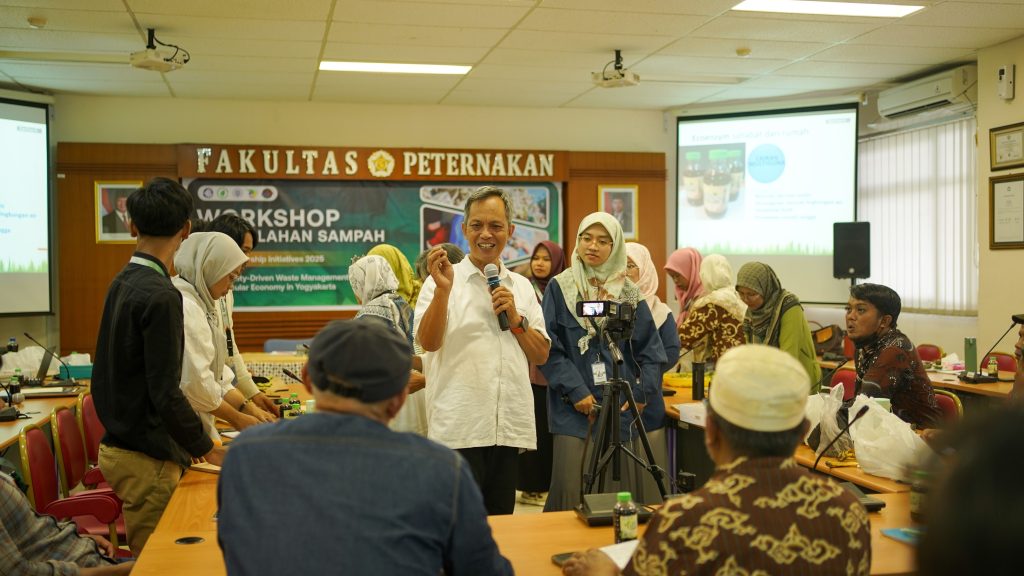
CircuLife serves as a platform for education on economically valuable waste management, including transforming vegetable and fruit organic waste into eco-enzyme, a versatile biotechnological innovation.
Toward a Circular Future
At its core, CircuLife promotes the principles of the circular economy, where materials are reused, regenerated, and reintegrated into economic cycles. This approach challenges the linear “take-make-dispose” model that has dominated waste management practices for decades.
By empowering communities, strengthening local institutions, and fostering cross-sector collaboration, CircuLife demonstrates how grassroots leadership can contribute meaningfully to national and global sustainability goals.
As Indonesia grapples with its waste emergency, initiatives like CircuLife offer a hopeful reminder that transformative change often begins at the community level—driven by knowledge, collaboration, and a shared commitment to environmental responsibility.