Voices from the Sylff Community
Mar 18, 2026
Insights from Fieldwork in Cambridge on Whaling’s Self-Policing Regime
A month of SRG-funded research in Cambridge gave Swati Malik (Geneva Graduate Institute, 2020) access to IWC archives and whaling experts, illuminating how inspections evolved in the whaling regime and what a self-policing regime reveals about enforcement, accountability, and cooperation.
* * *
My doctoral research examines how international treaties use inspections to enforce compliance, focusing on three regimes: chemical weapons disarmament, torture prevention, and whaling regulation. Each of these regimes approaches inspections differently—from the rigorous, treaty-empowered inspections under the Chemical Weapons Convention to the collaborative monitoring of the torture-prevention regime, and finally to the more limited and ad-hoc oversight in the whaling regime.
This article centers on the last of these inspection categories: the regulation of whaling under the International Convention for the Regulation of Whaling (ICRW).
In October 2025, supported by a Sylff Research Grant (SRG), I conducted fieldwork in Cambridge to explore how the International Whaling Commission (IWC)—the treaty body established by the ICRW—handles inspections and compliance. This trip was the capstone of my comparative study, following earlier field research on the other two regimes. While my research on inspections in the other two regimes may be mentioned as part of the broader context of my PhD research, the narrative below focuses specifically on my Cambridge field visit.
My interest in inspections in the whaling regime stems from the striking contrast they provide to more institutionalized inspection systems in international law. Whaling has long been a flashpoint between conservation goals and state sovereignty. Unlike disarmament treaties that deploy professional inspectors, the ICRW relies heavily on member nations to police themselves, thus raising questions about accountability.
I chose to study the whaling regime because it illustrates a challenging scenario: how does a country ensure compliance with international conservation rules when oversight is largely voluntary? By delving into the archives of the IWC and speaking with experts in Cambridge, I hoped to uncover how this regime evolved, how it tries to monitor whaling activities, and what lessons its successes and failures hold for international law.
The SRG-funded fieldwork in Cambridge enabled me to access materials unavailable elsewhere and provided nuanced insights into whaling inspections that complement the other case studies in my thesis.
Accessing the IWC Archives in Cambridge
The IWC Secretariat is headquartered just north of Cambridge in the village of Histon. For several days, I commuted from my hotel to the Secretariat’s modest offices—a journey that underscored the unassuming setting of this global regulatory body. My primary objective was to examine inspection reports and compliance records that are not available online.

Victory House in Histon, which houses the International Whaling Commission’s headquarters. (Photo courtesy of the author)
Beyond observer reports, the archives contained internal meeting minutes and communiqués grappling with enforcement issues. Reviewing these historical records was a highlight of my fieldwork. In particular, I discovered evidence of how shortcomings in the regime’s inspection mechanism had real consequences.
One striking find was a file concerning the Soviet Union’s whaling activities, which included scientific papers from the early 1990s revealing that the USSR had grossly underreported its whale catches for decades. This revelation, which only came after the end of Soviet whaling, underscored the limitations of an oversight system that relied on national inspectors and honesty.
Cambridge’s Extensive Resources
In addition to the IWC archives, Cambridge’s extensive resources provided many supplementary materials for my research. The University of Cambridge houses multiple libraries and collections, which proved invaluable for gathering context and secondary literature on whaling. While there, I was able to consult historical publications on the whaling industry. I also accessed scientific reports on whale populations and their conservation status to understand the ecological backdrop against which the IWC made decisions.
Cambridge is also home to the Scott Polar Research Institute (SPRI), which maintains archives on polar exploration and whaling. After visiting the Polar Museum, I spent time in SPRI’s library reviewing historical logbooks and photographs from Antarctic whaling expeditions. These materials were not directly related to legal inspections, but they enriched my understanding of the whalers’ world—the operational side that inspectors later tried to monitor.
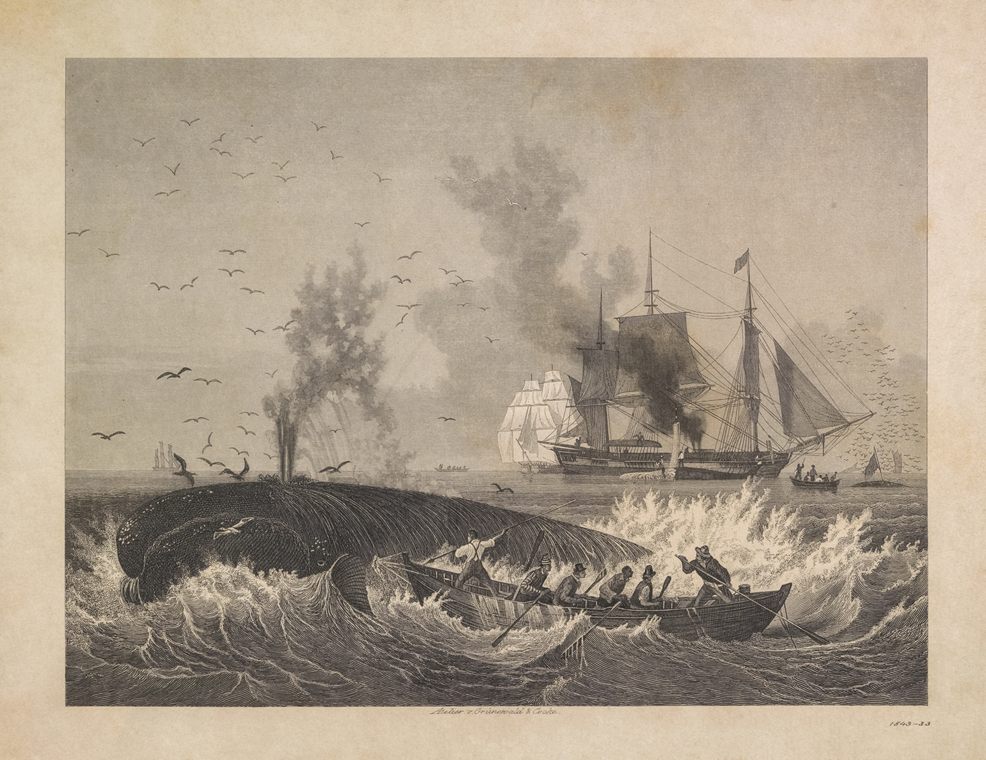
An old engraving portraying a whaling chase by a small crew of rowers through rough surf—a scene of danger and adventure very different from the technology‑driven methods of modern whaling. (©Patstock via Getty Images)
Seeing century-old harpoon logs and sepia-toned photos of whaling ships in icy waters gave me a visceral sense of the industry’s heritage. This, in turn, helped me appreciate why establishing inspections was so contentious; whaling had deep economic and cultural roots, and external oversight was sometimes perceived as an affront to national traditions.
Another key component of my fieldwork was engaging with experts through interviews and informal conversations. Cambridge, with its vibrant academic community and proximity to the IWC headquarters, offered an excellent opportunity to speak directly with individuals knowledgeable about whaling governance. While there, I was also able to conduct two interviews with individuals who had been part of their respective countries’ whaling expeditions as inspectors on board whaling vessels.
Findings: The Whaling Inspection Regime under the ICRW
By the end of my fieldwork, I had assembled a detailed picture of how inspections (or the lack thereof) operate in the whaling regime. One key finding was that the ICRW’s approach has always been decentralized and state-led. Unlike the Chemical Weapons Convention, which employs independent inspectors, the ICRW from its inception placed the burden of verification on each member nation. These national inspectors were employed by their own governments, not by an international body—a fact that inherently limited their neutrality.
The International Observer Scheme (IOS) of the 1970s was the IWC’s attempt to remedy this weakness by adding a layer of third-party oversight. My research confirmed that the IOS did somewhat improve transparency—observers from different nations were able to cross-verify catches and occasionally caught discrepancies in logbooks. However, the scheme had a limited lifespan. It effectively ceased once the commercial whaling moratorium took effect in 1986–87, as there were fewer whaling operations to monitor (and political enthusiasm for maintaining observers waned when the focus shifted to simply stopping whaling).
After that, the IWC entered what might be called a “post-inspection” era. The moratorium meant that in theory there was not much to inspect, aside from scientific permit whaling and aboriginal subsistence whaling. In practice, however, certain countries continued significant whaling under exemptions. All oversight in these cases was done through paperwork—catch reports submitted by countries, scientific data, and occasional reviews—but there was nothing like the robust inspection regimes of other treaties.
My findings highlight several implications of this light-touch enforcement. For one, compliance becomes a matter of trust and diplomacy rather than verification. IWC meetings often devote time to “infractions reports,” where nations publicly report any violations (such as an accidental taking of a protected whale) and explain remedial actions. This process creates peer pressure, but there is no real penalty if a nation fails to self-report or justify its actions. Through interviews and documents, I learned that this system led to frustration among the IWC’s conservation-minded members.
Not all findings were negative, however, as the fieldwork also shed light on how the IWC has adapted its compliance approach in innovative ways. In recent years, the Commission has emphasized transparency and collaboration through tools such as voluntary DNA registries of whale meat (to detect illegal catches entering markets) and improved reporting requirements for scientific hunts.
While these are not “inspections” in the classic sense, they are mechanisms that contribute to accountability. One might say the IWC compensates for its lack of enforcement power by leveraging science and public opinion to keep countries in line.
When I compare the archival records from the 1970s with the whaling dynamics in 2025, it is clear there has been an evolution. The exploitative mentality of the mid-twentieth century has given way to a broader conservation ethos, resulting in some improvements in compliance. For example, no IWC member openly defies catch limits for endangered species today, which was not the case in earlier decades. Whale populations have benefitted, with many species beginning to recover under the moratorium. Thus, even a relatively weak inspection regime, paired with a strong norm like the moratorium, can have significant impact.
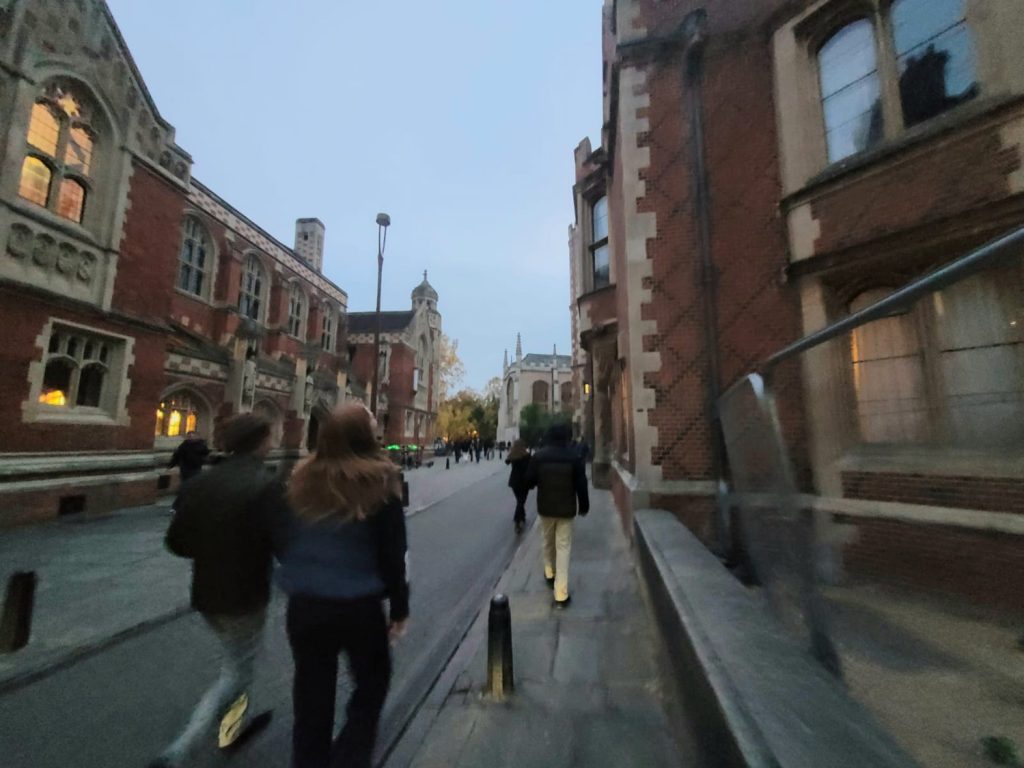
I spent a wonderful autumnal month in Cambridge happily hopping between colleges, libraries, bookstores, coffee shops, and the IWC’s headquarters. (Photo courtesy of the author)
In summary, my Cambridge fieldwork revealed that the whaling regime’s inspection system is fundamentally a story of trade-offs. On the one hand, keeping inspections state-led preserved national sovereignty and facilitated political agreement (many countries might have left the IWC if intrusive inspections were forced upon them).
Conversely, this choice left persistent gaps in enforcement, some of which were tragically exploited, as the Soviet example illustrates. These findings form a crucial part of my thesis’s comparative analysis, demonstrating how a weaker, voluntary inspection framework struggles to achieve the same level of compliance as the stronger, institutionalized inspections of other regimes. Yet, the whaling case also provides insight into alternative compliance tools—diplomacy, science, and public pressure—which are increasingly relevant in international law where formal enforcement often proves elusive.
Reflections and Broader Significance
This field visit to Cambridge was not just an exercise in data collection. It was also a journey that illuminated the human and societal dimensions of my research. Working in the archives and speaking with people on the ground deepened my appreciation for how international law functions in practice: through painstaking consensus-building, occasional bold leadership, and the quiet dedication of individuals behind the scenes.
I was struck by the universality and diversity of the human condition reflected in the whaling regime’s story. At its core, the idea of inspections in international treaties speaks to shared values: accountability, trust, and stewardship. Every nation, at least rhetorically, agrees that we must preserve ocean life for future generations and follow rules we have collectively set. This is a common thread of humanity—recognizing that some issues, like conserving whale populations, transcend borders and require mutual oversight.
At the same time, the implementation of that principle encounters the diversity of human perspectives and cultures. Whaling is not merely a practical activity, as it is woven into cultural narratives, national identities, and human livelihoods. What I witnessed through Cambridge’s documents and discussions is that an inspection regime must contend with these differences.
For example, the presence of an inspector on a whaling vessel may be perceived by one nation as an essential mechanism for the protection of global heritage, while another may view it as intrusive oversight that calls its way of life into question. The whaling case vividly demonstrates how one size does not fit all. This realization has made my research analysis more nuanced; rather than viewing the IWC system as simply “weak,” I now understand it as a product of compromise, an attempt (however imperfect) to respect diversity while still upholding a universal conservation objective.
These reflections also raise broader questions that make for a separate discussion: can international law find creative ways to enforce rules without alienating those who must abide by them? How do we build compliance mechanisms that are both effective and seen as legitimate by different communities? These questions go beyond whaling, as they touch on the very nature of global cooperation.
On a personal note, my time in Cambridge taught me the value of stepping outside the narrow confines of my academic research and engaging with the narratives and people behind the law. Inspections, whether in disarmament or human rights or whaling, are tools by which we act as trustees—we check on each other to uphold a common good. This fieldwork reinforced for me why this topic matters for our shared planet.
In the case of whaling, the societal contribution of better inspections (or analogous oversight) could mean the difference between whales’ survival or extinction and between a fair global agreement or a collapse back into unregulated exploitation of the ocean’s living resources.

The author recently defended her doctoral thesis at the Graduate Institute in Geneva. She is very grateful to the Sylff Association for fully funding her studies at the Institute for two academic years between 2020 and 2022 and also for twice awarding grants that enabled her to undertake research visits to the Netherlands and the United Kingdom. (Photo courtesy of the author)
Conclusion
This fieldwork proved indispensable to my recently concluded PhD journey, allowing me to complete the comparative puzzle of inspections in international law by providing deep insights into the whaling regime—a case where both the cracks and potential of international oversight are on display.
In closing, I am grateful for the Sylff Association’s support that enabled this fieldwork. Without being on-site in Cambridge, I would have missed crucial evidence and perspectives that now enrich my thesis chapter on inspections in the whaling regime. By focusing on whaling—an issue that at first might seem niche or historic—I ended up exploring questions that lie at the heart of how we manage our global commons and uphold international norms.