Sylff News
May 20, 2026
Online Orientation Meeting with Three New Pedro Arrupe Fellows
Three new Sylff fellows have been selected for the 2026–27 academic year at the Institute of Political Education “Pedro Arrupe”: Riccardo Lana, Caterina De Benedictis, and Giorgio Rausa. While their research backgrounds differ, all three share a strong commitment to addressing marginality through socially engaged scholarship and active community involvement.
Their work reflects the emphasis that the Idea-Action Research Program—Pedro Arrupe’s name for the Sylff program—places on turning academic research into concrete action, particularly in contexts marked by social inequality, institutional fragility, and marginalization. They represent a cohort united by a common concern for social inclusion, democratic innovation, and leadership through practice.
An online orientation meeting for the new fellows was held on May 18. Also in attendance were Pedro Arrupe General Secretary Massimo Massaro—himself a Sylff fellow and chair of the institute’s Sylff steering committee, as well as founder of the Idea-Action program—and members of the Sylff Association secretariat.
Research Presentations
Opening remarks were made by Massaro, who expressed gratitude for Sylff’s support of hundreds of outstanding graduate students at Pedro Arrupe—most of them Sicilians—and emphasized the institute’s commitment to turning ideas into action through the development of human capital to address social and political challenges. Welcome remarks by Tokyo Foundation Executive Director Masato Seko were then read by Program Officer Konatsu Furuya of the secretariat, who also gave a presentation introducing the Sylff program.
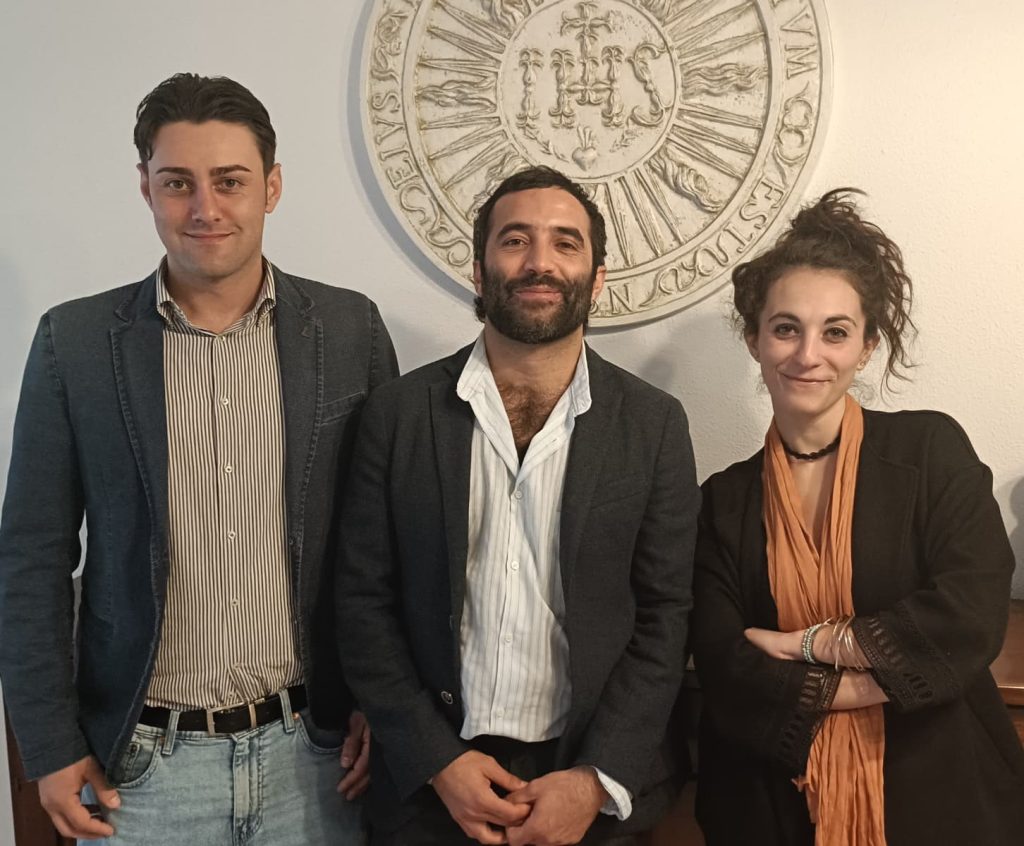
The three Idea-Action fellows for 2026 are, from left, Riccardo Lana, Giorgio Rausa, and Caterina De Benedictis.
Riccardo Lana led off the fellows’ presentations by describing his applied research project on youth participation and deviance prevention, focusing on the CEP (Centro Espansione Periferica) low-income housing neighborhood of Palermo. Lana’s academic and professional interests span research, sports, and community development. Rather than approaching societal issues solely from an academic perspective, he combines fieldwork, analysis, and personal engagement to produce research-oriented outcomes with measurable social impact, reflecting his strong commitment to socially responsible scholarship and leadership grounded in action.
During the Sylff fellowship, Lana will explore whether improving the quality and accessibility of sports programs can help reduce juvenile delinquency and examine how social, cultural, residential, and economic environments shape young people’s aspirations. The project aims to provide policymakers and stakeholders with guidelines for neighborhood revitalization, raise community awareness of sports as a means of social integration and health, and support local organizations in securing sustainable funding for sports initiatives.
Lana’s methodology combines participant observation through volunteering at the San Giovanni Apostolo center—the only third-sector organization providing sports programs in CEP—with semi-structured interviews and focus groups with youth, families, and community workers, as well as quantitative and qualitative assessments of local sports facilities. In addition to preparing a peer-reviewed journal article in sociology of sport or social policy, he aims to strengthen transnational and interdisciplinary dialogue, leveraging his experience as a project manager in European funded programs to bridge research, policy, and practice. Ultimately, his work seeks to contribute to the empowerment of marginalized youth and the revitalization of their communities.
Caterina De Benedictis is a researcher whose academic and professional work focuses on institutional transformation in Southern Italy, which she views not as a peripheral space but as a laboratory of democratic innovation. Through research on the social reuse of assets confiscated from organized crime, community enterprises, renewable energy communities, and shared administration, she has consistently engaged with territories shaped by socio-spatial marginality, conflict, and institutional fragility, viewing these conditions as opportunities for civic leadership and institutional learning. Grounded in theoretical frameworks of socio-spatial justice, the capabilities approach, and institutional learning, her work explores how urban conflict can become a democratic learning process and a driver of institutional transformation.
During the fellowship period, De Benedictis will conduct a qualitative, process-oriented study of the Civita district in Catania, a historic waterfront district marked by strong socio-spatial stratification, tourism-driven transformation, and conflicts such as those surrounding pedestrianization. Focusing on the coexistence of long-term residents, migrant communities, cultural spaces, and civic actors, her research asks who has the right to shape urban transformation and investigates how tourism-oriented development can result in decision-making marginality among historical residents.
Combining socio-spatial policy analysis, interviews, deliberative focus groups, and participatory action research, she will also establish a co-institutional laboratory that brings together citizens and municipal actors to transform conflict into negotiation, rebuild trust, and generate shared rules. This work aims to experimentally develop the concept of “co-institution”—defined as the mutual transformation of citizens and institutions through structured interaction—while producing outputs such as a co-institution pact, civic leadership tools, and indicators of socio-spatial justice. A comparative dimension in other Southern Italian cities will further support the development of transferable, policy-relevant models for democratic governance and social innovation.
Giorgio Rausa is a clinical psychologist whose academic and professional path reflects a deep commitment to supporting individuals and communities experiencing social, educational, and economic deprivation. Through years of work in marginalized neighborhoods of Palermo, Rausa has engaged closely with children, families, teachers, and educators, guided by the belief that leadership is built through sustained action, care, and presence within communities. Drawing on a phenomenological-relational perspective and influenced by practices such as meditation in Thich Nhat Hanh’s Plum Village tradition, his work emphasizes awareness, embodiment, and compassion as foundations for addressing relational difficulties and preventing conflict, particularly during the critical transition from childhood to adolescence.
During his Sylff fellowship, Rausa will pursue an interdisciplinary research project integrating applied Buddhist philosophy, Gestalt therapy, critical pedagogy, and socio-emotional educational research. Building on his observation that impulsive or aggressive behaviors often reflect unmet relational needs and difficulties in staying in contact with emotions and the body, he adopts a mixed-methods approach combining qualitative and quantitative tools.
His project includes activities such as talking circles, movement- and sports-based engagement, breathing and grounding practices, expressive workshops, and mindful walks, alongside participatory and reflective research methods. Central to this work is the creation of safe, nonjudgmental spaces that foster emotional awareness and relational presence, enabling young people to recognize and regulate their responses. Through a comprehensive literature review, an academic seminar in Palermo, and the preparation of articles for peer-reviewed publications, Rausa aims to develop practical, transferable tools for professionals, while contributing to the prevention of violence and the cultivation of healthier, more reflective forms of collective life.
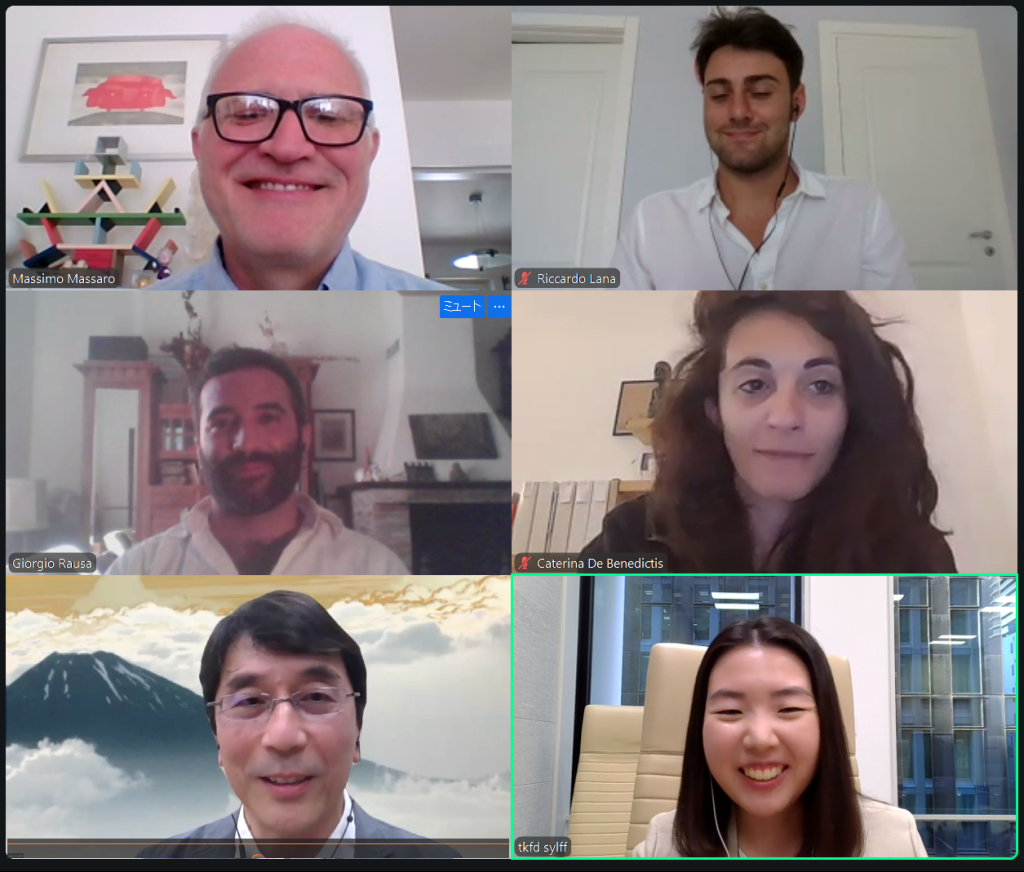
Orientation meeting participants included, clockwise from top left, Massimo Massaro, Riccardo Lana, Caterina De Benedictis, Konatsu Furuya, Nozomu Kawamoto, and Giorgio Rausa.
The Sylff Association secretariat looks forward to supporting the research of the three new Pedro Arrupe fellows and to seeing the academic contributions and social impact emerging from their work. Through their engagement with practical issues confronting the community, this cohort exemplifies the Sylff mission of linking academic excellence with action for the public good. The secretariat extends its warmest wishes for the success of their research activities and hopes that the fellowship period will serve as a foundation for lasting academic, professional, and civic contributions. (Compiled by Nozomu Kawamoto)