Sylff News
Feb 17, 2026
Exploring the Upsides of Dark Tourism: Lessons from the Holocaust Memorial
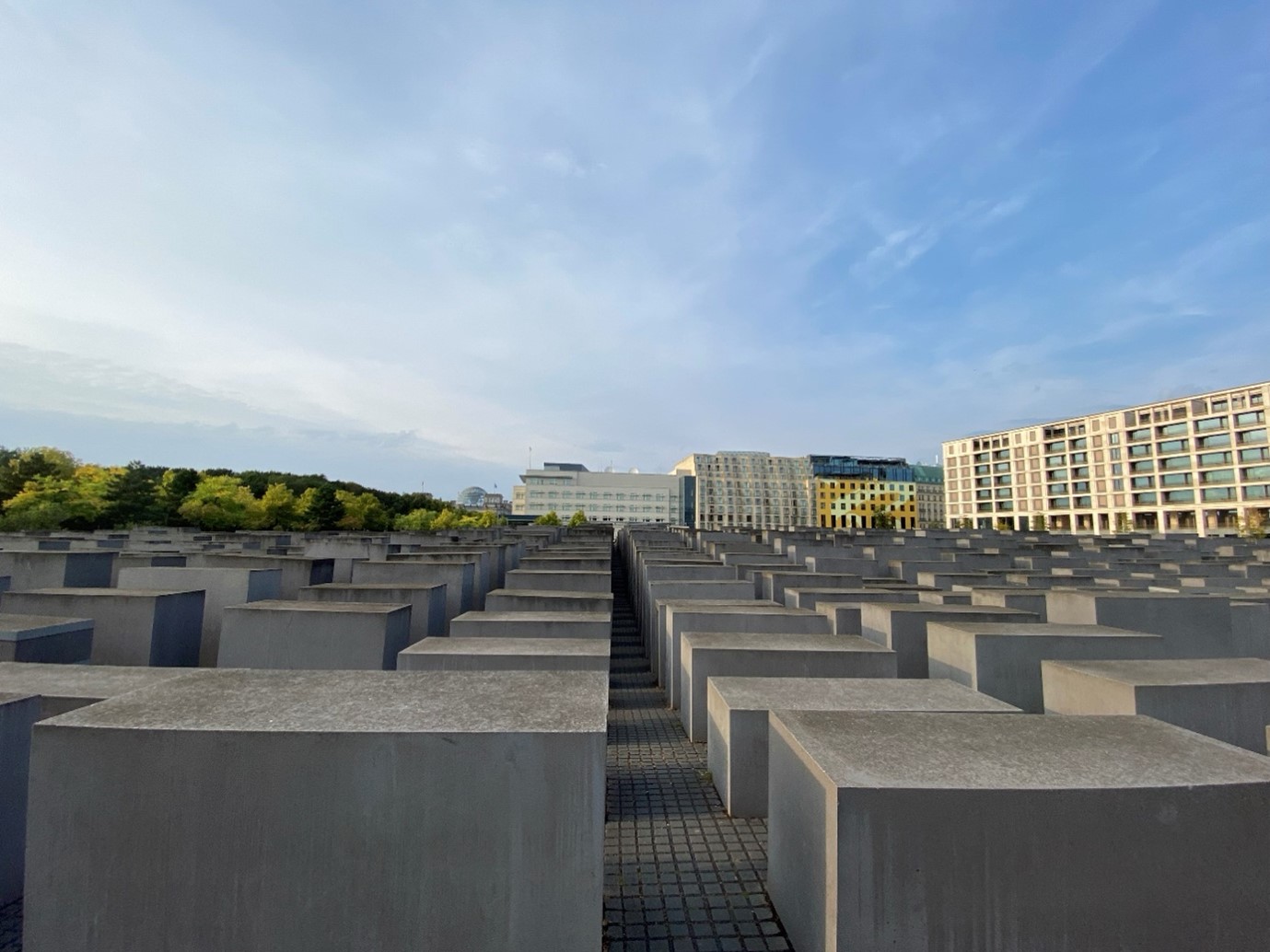
Memorial to the Murdered Jews of Europe in Berlin, Germany. (©Hassan Ali)
Farhad Nazir, a Sylff fellow at the University of Coimbra, has co-authored a book chapter with Hassan Ali of the Eberswalde University for Sustainable Development, Germany. The chapter, titled “The Holocaust Memorial and Upsides of Dark Tourism in the Modern Times,” appears in The Emerald Handbook of International Dark Tourism.
Nazir recently completed his doctoral degree in Tourism, Heritage, and Territory at Coimbra. He was awarded a Sylff fellowship in 2022 and a Sylff Research Grant in 2024 and 2025.
The study examines the potential benefits of dark tourism at Berlin’s Holocaust Memorial—officially the Memorial to the Murdered Jews of Europe—focusing on its social, educational, psychological, and economic dimensions. The facility is the central subject of the research, a place to reflect on and remember the atrocities perpetrated during World War II.
On a societal level, the study discusses how the memorial can foster understanding and compassion by immersing visitors in the victims’ experiences and suffering. From an educational perspective, it considers the memorial’s capacity to provide historical context and promote critical thinking regarding the consequences of bigotry and prejudice. From a psychological dimension, the study investigates the memorial’s potential as a place for healing and dealing with loss and pain, while encouraging resilience and hope.
Additionally, the chapter explores the site’s role in enhancing social engagement, expanding educational possibilities, and contributing to the local economy by attracting tourists and reinforcing solidarity with affected communities. It underscores the memorial’s importance as a dark tourism destination in modern times, showcasing its function in promoting empathy, awareness, and respect for human rights. The study also provides practical implications for stakeholders directly or indirectly associated with shaping dark tourism experiences.
Link to the book chapter: https://doi.org/10.1108/978-1-80592-501-920251024