Voices from the Sylff Community
Feb 25, 2026
Legian at Night: Reflections on Luxury Tourism and Local Life in Bali, Indonesia
In a preliminary report on his SRG study into Bali’s luxury tourism, A. Faidlal Rahman (Gadjah Mada University, 2008–09) offers his personal thoughts on how upscale visitor experiences rely on the labor, lives, and adaptability of the local community.
* * *
My current research into “Luxury Experience, Empowerment, and Their Impact on Tourist Satisfaction” did not begin with data or theory. It began with night-time walks through the streets of Legian—a vibrant, beachfront district in southern Bali.
As night falls, Legian comes alive. Neon lights flicker on, music spills from bars and cafés, and the sidewalks fill with people speaking different languages. For many visitors, Legian is a place to be free, have fun, and enjoy the nightlife.
But as a Sylff fellow who has stayed in many of Bali's fancy hotels, I see Legian a little differently. This area shows how luxury tourism, urban development, and local life are interconnected, even amid the crowds and noise.
As I walk down Legian's main street, music is everywhere—some quickly fading away and others loud enough to shake the pavement. Small bars with live bands sit next to older buildings and longstanding local shops. Tourism workers stand in front of restaurants and attractions, serving food, guiding guests, or just watching the night unfold.
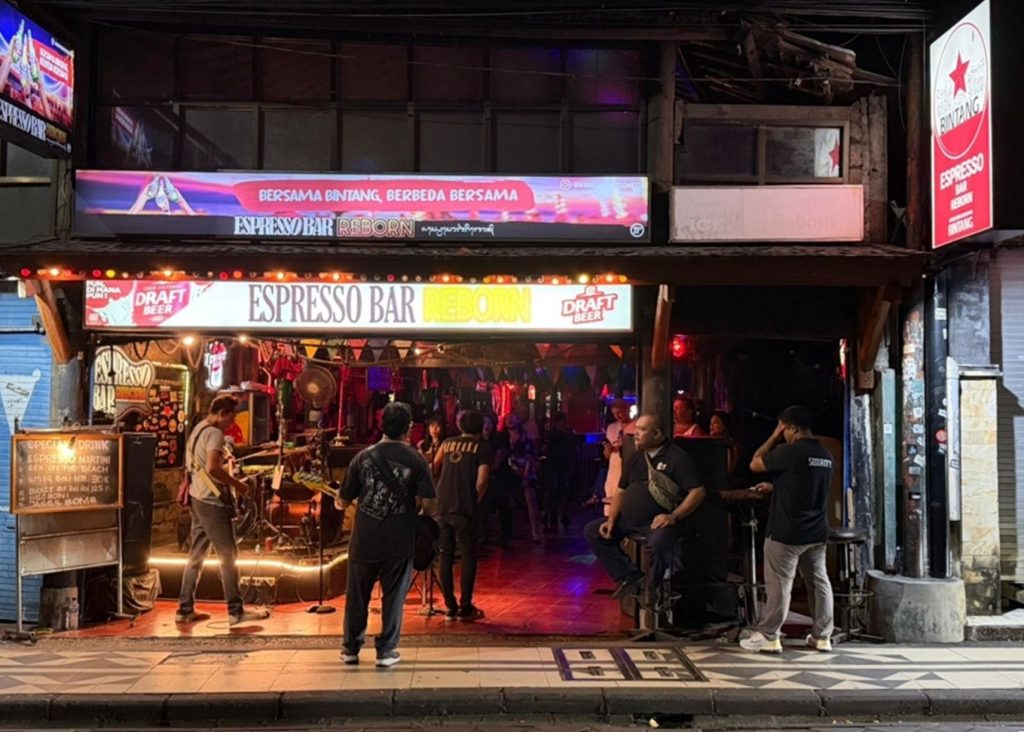
Live music fills the streets of night-time Legian.
Many electrical wires crisscross above the street—a reminder of how quickly this neighborhood has grown, often outpacing institutional planning. Legian’s layout is imperfect and improvised, shaped by flexibility, compromise, and the routines of daily life.
This field experience is important to me on a personal level. My interests go beyond just academic work. I can see how upscale travel is planned and managed by watching how luxury hotels operate. But Legian prompts a deeper question: who sustains this luxury?
Legian as a Place to Learn
The atmosphere inside Legian’s fancy hotels feels calm and controlled. Service follows international standards. Building design takes into account local traditions. Each guest gets personalized attention, and a sense of orderliness reinforces the feeling of richness.
But as soon as I step outside the hotel grounds, the mood changes. Big tourism businesses operate alongside local shops, informal vendors, and local residents. Life is busier, more fluid, and more interactive outside the hotel walls. It becomes clear that luxury tourism never exists in isolation.
Many hotel workers I met lived in Legian. During the day, they work in highly professional, polished hospitality environments. At night, they return to neighborhoods that have been heavily shaped by tourism. For them, the nightlife in Legian is not entertainment—it is a part of daily life.
Even though my time in Legian was limited, I was able to see how local life and international tourism interact. The people working behind the scenes—hotel staff, suppliers, small business owners, long-established shopkeepers, and informal transport drivers—are the ones responsible for making guests feel like they are in luxury. Their labor is the reason why tourism works.
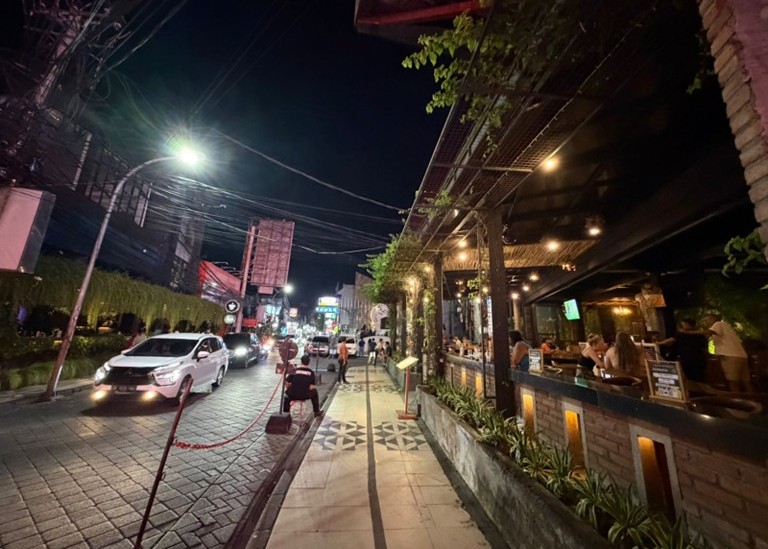
The unhurried atmosphere of Legian’s nightlife.
This experience has changed how I approach the study of tourism. Thanks to my SRG award, I was able to slow down, hear more stories, and spend more time in the field. I learned that finding quick fixes do not always lead to the best solutions; understanding a place comes from small, everyday moments, such as short conversations with employees heading home late at night, watching how the street changes from hour to hour, or noticing the contrast between the quiet of hotels and the noise of the streets outside.
This experience also made me think about the social responsibility of researchers in the global academic community. The support I received from Sylff was not only a personal benefit but also reminded me that knowledge should ultimately contribute to society. Legian makes this clear. Tourism is more than just an industry; it also involves people, jobs, homes, and the environment.
What I saw in Legian can be found in tourist destinations all over the world. Global competition and rapid growth often put a strain on local life and identity. These challenges are not unique to Bali—they are part of a larger global tension between luxury tourism, sustainability, and community well-being.
Legian taught me that tourism is not simply about visitor numbers or revenue. It is about who benefits, who has to adapt, and who bears the consequences. The crowded sidewalks, late-night businesses, and multitasking employees are reminders that tourism is much more complicated than it looks.
Every night that I walked through Legian, I saw how global issues like sustainability and the search for authenticity play out in the details of everyday life. For people who live and work in tourist areas, these are not abstract concepts but everyday realities.
For me, Legian has become a place to learn. I now understand that tourism is a constantly evolving social phenomenon—not just an industry or a visitor’s experience but a space where people, values, and global responsibilities intersect.