Voices from the Sylff Community
Aug 21, 2026
Whoosh: China-Japan Infrastructure Competition in Indonesia’s Rail Sector
Indonesia’s first high-speed railway emerged from intense competition between China and Japan. Through interviews and archival research, Caixia Mao (Columbia University, 2024) shows how their contrasting financing models create different forms of political, institutional, and commercial engagement in Indonesia.
* * *
On October 17, 2023, the first high-speed railway (HSR) in Southeast Asia was launched between Jakarta and Bandung. With a maximum operating speed of 350 km per hour, it became the fastest commercial HSR available at the time, matched only by services in China. The event was commemorated at a ceremony in Beijing, attended by Indonesia President Joko Widodo (Jokowi) and Chinese President Xi Jinping. Jokowi named the HSR “Whoosh,” inspired by the sound of the train. The project was developed with financial and technological support from China, and Xi described it as a “Golden Sign” of high-quality China-Indonesia cooperation under the Belt and Road Initiative (BRI) (Chinese Ministry of Foreign Affairs 2023).
The project received unprecedented attention from policymakers, the media, and scholars worldwide due to the intense donor competition between Japan and China. In fact, the project was initially proposed by Japan in 2007 during the administration of President Susilo Bambang Yudhoyono (SBY) as a showcase for its signature Shinkansen technology. When Jokowi came to power in 2014, however, he expressed concerns about the project’s high cost. China then entered the competition, and Jokowi successfully leveraged donor rivalry to engage with the highest levels of the two countries’ political leadership.
The primary data collection method of my research—supported by an SRG award—was expert interviews in Chinese, Japanese, and English. I also conducted archival research in Tokyo, Jakarta, and Leiden to revisit the origins of railway development in Japan and the former Dutch East Indies, as well as broader infrastructure development in post-independence Indonesia. The findings from interviews and archival research were triangulated with policy documents, media reporting, and official statistics in Chinese, Japanese, English, and Bahasa Indonesia.
Chinese B-to-B Versus Japanese G-to-G Approaches
When Indonesia eventually awarded the project to China in October 2015, media and political narratives emphasized that Chinese business-to-business (B-to-B) financing between Indonesian and Chinese state-owned enterprises (SOEs) better suited Indonesia’s needs than Japan’s government-to-government (G-to-G) proposal. Yet, at the time, political leaders in all three countries knew little about the practical implications of B-to-B versus G-to-G arrangements.
To unpack these differences, I examined another flagship railway project, funded by Japan: the Jakarta mass rapid transit (MRT) system. As one Indonesian ministry official in charge of Jakarta MRT project explained, “You cannot say that Japan does the MRT better than China, because the terms and conditions of the two projects are totally different.” What are the differences between the two financing arrangements? What do these differences reveal about Chinese, Japanese, and Indonesian objectives?
I applied a techno-politics theoretical framework to understand how the railway technologies are used as a tool to achieve political goals by Indonesian, Chinese, and Japanese governments and political-economic elites. Rather than focusing solely on state-of-the-art railway technologies, I examined the political and economic relationships behind the Jakarta-Bandung HSR and Jakarta MRT and how technologies alter such relationships. Specifically, I focused on donor-recipient relations between China and Indonesia and between Japan and Indonesia, as well as donor competition between China and Japan.
In the short term, the HSR project served Jokowi’s political goals. From a longer-term perspective, however, by connecting contemporary diplomacy with the colonial history of the Dutch East Indies and Japanese wartime rule, I argue that railway technologies have long been used as instruments of imperial expansion. I also examined the extent to which China continued or departed from the practices of former colonial powers.
At the same time, launching expensive and highly publicized railway projects entails high political and commercial risk and requires sustained political and financial commitment. Comparing Chinese B-to-B with Japanese G-to-G arrangements reveals contrasting institutional strategies among Chinese and Japanese infrastructure assemblages for becoming entangled with or disentangled from political, commercial, and financial risks embedded in Indonesian society.
Railway Technologies as Symbols of Colonial and Industrial Power
My research traces how railway technologies were historically used as representations of state military and engineering power in Japan’s former colonies and how such symbolic functions became mobile in both state and business spheres. Elements of this logic can also be observed in today’s Chinese and Indonesian efforts to promote the Jakarta-Bandung HSR.
One historical example is the Asia Express train built by Japan in occupied Manchuria in 1934. The train traveled at an average speed of 83 km per hour and reached a maximum speed of 130 km per hour (Yamanouchi 1999). Its technological sophistication and luxurious amenities exceeded those of railways operating in Japan and served as a showcase of Japanese imperial power and industrial capacity for both foreign and domestic audiences (Matsusaka 2001).

Fashionably dressed passengers relaxing inside Manchuria’s Asia Express train, which served as a showcase of Japanese industrial power. (Photo taken by the author at the Railway Museum in Japan.)
When Japan captured the world’s attention with the launch of the Shinkansen in 1964, operating at speeds of 200 km per hour, railways again became a powerful symbol of national achievement. Introduced in conjunction with the Tokyo Olympics, the Shinkansen helped rebrand Japan’s global image and supported the promotion of Japanese goods and services in global markets (Abel 2022).
This emphasis on technological superiority continues to shape Japan’s overseas railway projects. The Jakarta MRT was promoted under the banner of “All-Japan” technologies and based on Tokyo’s Yamanote Line. The project was financed through Special Terms for Economic Partnership (STEP) loans, which are tied to the procurement of Japanese goods and services but at highly concessional interest rates.
Yet, Japanese dominance in Indonesian infrastructure sector has been challenged since China’s successful bid for the Jakarta-Bandung HSR. As a latecomer in the HSR sector, China has expanded its HSR network at an astonishing pace over the past few decades. Today, it has become a major exporter of HSR technology, competing directly with Japan, and it has promoted HSR as a key industry through which China seeks global recognition for technological innovation.
Like the Japanese experience after the launch of the Shinkansen, Chinese success in HSR innovation—based on a strategy of “introduction, digestion, absorption, and re-innovation”—has become part of a broader effort to rebrand the country’s image from “Made in China” to “Create in China” (Gao 2020). This rebranding as an HSR innovator attempts to wipe away the perception of China as a low-cost factory and position it instead as an industrial power capable of producing high-quality technologies and products. Most importantly, by successfully launching the Jakarta-Bandung HSR, China has demonstrated to Indonesian political and economic elites, as well as the general public, that China is able to deliver infrastructure projects as Japan has done so far.
(Dis)entanglement of Chinese and Japanese Infrastructure Assemblages
When examining the loan conditions under the B-to-B and G-to-G arrangements, two very different pictures emerge of the Jakarta-Bandung HSR and Jakarta MRT projects.
Under the Japanese G-to-G framework, a key loan condition is the provision of an Indonesian government guarantee. This means that in the case the project itself is unable to repay its loans, the Indonesian Ministry of Finance—or in the case of Jakarta MRT, the Jakarta provincial government—is responsible for repayment. Moreover, as the main implementation and project management agency on the Japanese side, the Japan International Cooperation Agency (JICA) requests the Indonesian government to bear the financial costs and administrative burden of land acquisition.
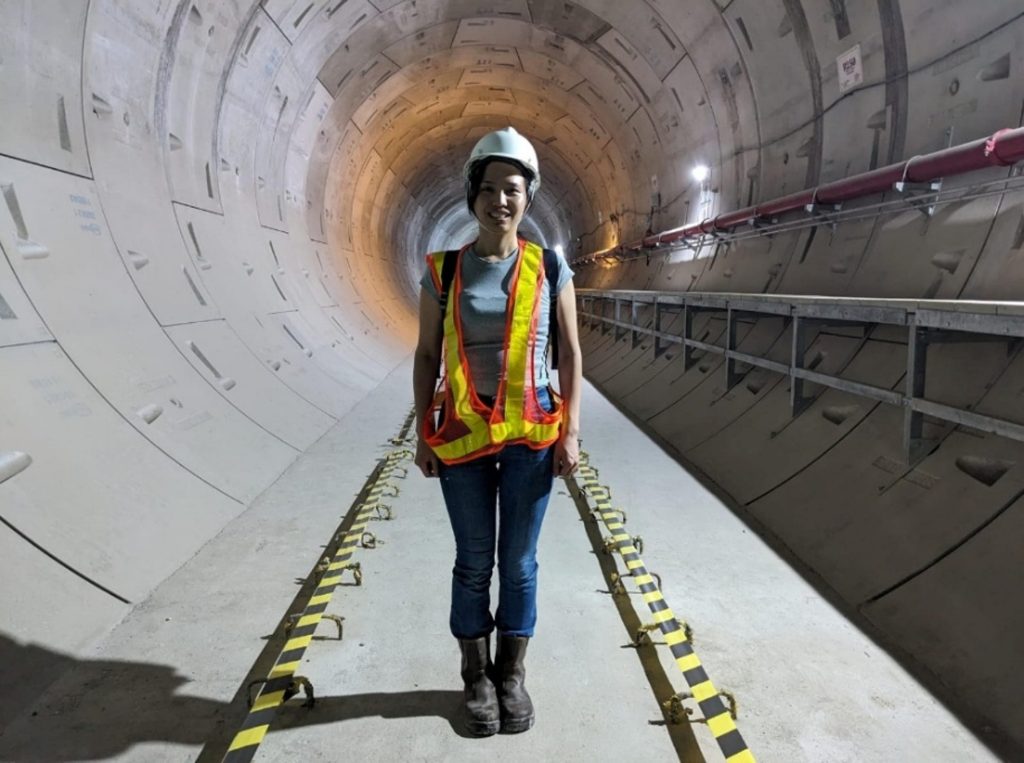
The author visiting the Phase 2A tunnel construction site near Monas, Jakarta, in December 2024 as part of a public tour organized by Jakarta MRT.
Japanese companies, in this arrangement, act primarily as contractors and receive payment through JICA. Most importantly, they do not assume any political, financial, or commercial responsibility for the operation of the project. In other words, once construction is completed and the project enters operation, Japanese companies largely conclude their involvement and leave operations and management to their Indonesian counterparts.
Another important implication of the state guarantee is that Indonesian central and local governments are expected to provide financial support where necessary, such as fare subsidies, to ensure that services can continue until ridership increases and the system becomes financially sustainable. Currently, the Jakarta MRT continues to receive subsidies from the Jakarta provincial government to keep fares affordable and encourage higher ridership.
The Chinese B-to-B arrangement for the Jakarta-Bandung HSR differs significantly. Chinese state-owned enterprises (SOEs) participate not only as contractors but also as investors through the joint Indonesia-China consortium Kereta Cepat Indonesia China (KCIC), established with Indonesian SOEs. Compared with the Japanese model, a key feature is that Chinese SOEs share responsibility for the project’s financial and commercial risks (excluding land acquisition) even after operations begin.
In theory, the absence of a state guarantee means the Indonesian government is not responsible for loan repayment or operating subsidies while the new line builds ridership. In practice, however, the application of a purely B-to-B model to a high-cost HSR project proved to be unrealistic. Indonesian SOEs participating in KCIC subsequently requested support from the Indonesian government, including capital injections to cover approximately US$1.24 billion in cost overruns and other operational expenses.
Finally, the comparison reveals different approaches to risk management and institutional engagement. While Japan attempts to disentangle itself from risks associated with local political and economic conditions, including exchange-rate fluctuations, land acquisition disputes, corruption, and questions of financial viability, it simultaneously becomes entangled with Indonesia’s administrative and regulatory systems through institutional coordination and extensive due-diligence procedures.
On the other hand, China seeks to accelerate implementation by disentangling itself from local administrative burdens through top-level political negotiations and strategic alliances that can bypass local bureaucratic procedures. Yet this approach can create deeper entanglement with top political leadership, which can make projects potentially more vulnerable to changes in government and shifting political priorities. By assuming greater financial and business risk, Chinese actors become more closely connected to local political elites and to long-term business cooperation.
Overall, the findings suggest that Chinese and Japanese infrastructure assemblages become entangled with Indonesian society in different ways. Japan’s model relies on institutional and administrative entanglement while minimizing direct commercial exposure. China’s model relies more heavily on political and business entanglement through investment and risk-sharing. These contrasting approaches offer important insights into how contemporary infrastructure competition is reshaping relations among China, Japan, and Indonesia.
References
Abel, Jessamyn. 2022. Dream Super-Express: A Cultural History of the World’s First Bullet Train. Stanford University Press.
Chinese Ministry of Foreign Affairs. 2023. “Xi Jinping Holds Talks with Indonesian President Joko Widodo.” October 17, 2023. https://www.mfa.gov.cn/zyxw/202310/t20231017_11162415.shtml.
Gao, Bai. 2020. “Three Theoretical Issues Concerning China’s HSR Innovation System.” In High-Speed Rail: An Analysis of the Chinese Innovation System, edited by Bai Gao, Guodong Li, and Zhibing Zhen, 1-34. World Scientific.
Matsusaka, Yoshihisa Tak. 2001. The Making of Japanese Manchuria, 1904-1932. Harvard University Asia Center.
Yamanouchi, Shuichiro. 1999. If There Were No Shinkansen: High-Speed Rail Experience from Its Birth to Today in Japan. Springer.