Voices from the Sylff Community
Sep 3, 2026
Behind the Glass Fortress: When Gender Justice Meets Bureaucracy at the ICC
SRG-supported fieldwork in The Hague led Bhavya Gupta (Jawaharlal Nehru University, 2023) beyond court judgments and legal texts into the inner workings of the International Criminal Court, revealing how institutional structures and bureaucratic processes shape the pursuit of gender justice.
* * *
The first thing I noticed during my fieldwork in The Hague was not a judgment, a courtroom argument, or a legal document. It was a building.
For much of modern history, sexual violence committed during armed conflicts was not considered an international crime. It was often treated as an unavoidable by-product of war or as a tactic of warfare, leaving prosecution largely to the domestic courts under each country’s criminal laws. The atrocities committed during the armed conflicts in the former Yugoslavia and Rwanda changed this understanding in the 1990s. The United Nations established the International Criminal Tribunal for the Former Yugoslavia (ICTY) and the International Criminal Tribunal for Rwanda (ICTR), which legally recognized conflict-related sexual violence as an international crime for the first time.
However, because these courts were ad hoc, being created specifically for those conflicts, they did not have jurisdiction elsewhere. They also did not have a police force of their own and relied on state cooperation to apprehend suspects. Consequently, when alleged criminals were high-ranking officials or war heroes in their own countries, such as Ratko Mladić or Radovan Karadžić, governments often actively obstructed the tribunals’ work for years.
In 2002, the International Criminal Court (ICC) was established as the first permanent institution empowered to prosecute the most heinous international crimes committed by individuals. Unlike the ICTY and ICTR, which were temporary tribunals created in response to particular conflicts, the ICC became a treaty-based, proactive, and permanent court independent of the United Nations. For the first time, the Rome Statute establishing the ICC codified specific forms of sexual and gender-based violence: rape, sexual slavery, enforced prostitution, forced pregnancy, enforced sterilization, gender persecution, and other similar crimes.
Initially, as a Global South scholar at a public university in India, I never imagined it would be possible to visit the Netherlands for field research on the ICC. Fortunately, I received a Sylff Research Grant, allowing me to spend two months in The Hague. I arrived hoping to understand how sexual and gender-based crimes are investigated and prosecuted by the ICC. What I found changed the way I understood the court itself.
From Court to Bureaucracy
The Rome Statute is regarded as a progressive legal instrument because it criminalizes specific forms of sexual violence committed during or in connection with armed conflict. But despite the comprehensive nature of the legal framework and important recent developments, prosecution outcomes remain uneven.
Several ICC cases provide some striking examples of this challenge. In the Bemba case, the Trial Chamber convicted Jean-Pierre Bemba, including for rape, but the Appeals Chamber subsequently acquitted him of war crimes and crimes against humanity. In Katanga, the Trial Chamber found that rape and sexual slavery had been committed but concluded that the evidence did not establish Katanga's responsibility for those crimes beyond a reasonable doubt. More recently, in Al Hassan, the Chamber found that acts of sexual violence had taken place but acquitted the accused of rape, sexual slavery, and forced-marriage charges due to insufficient evidence of his responsibility (International Criminal Court 2014, 2018, 2024).
These cases demonstrate that the problem cannot be understood simply as a matter of low conviction rates. Sexual and gender-based crimes can encounter obstacles at different stages of the criminal process, even when the underlying violence is established.
This observation led me to a different question. Existing scholarship has largely examined the ICC through legal doctrine, judicial decisions, and interpretations of the Rome Statute. I wanted to understand what happens inside the institution itself. Could organizational practices explain part of the gap between progressive legal norms and uneven outcomes?
My field research suggests that this is not just a question of low conviction rates. There appears to be systematic attrition at different procedural stages before a final judgment is delivered.
Seeing The Hague Through Its Buildings
During my fieldwork, the first thing that stood out was the architecture of The Hague’s international judicial institutions. Architecture is never neutral, and the relationship between the judge and the judged can be analyzed through the physical spaces where justice is performed.
For instance, the International Court of Justice (ICJ), housed in the Peace Palace, is unapologetically European, colonial, and regal. It embodies an old-world vision of diplomatic engagement among states. It does not try to be relatable to individual citizens and is a monument to Western legal tradition.
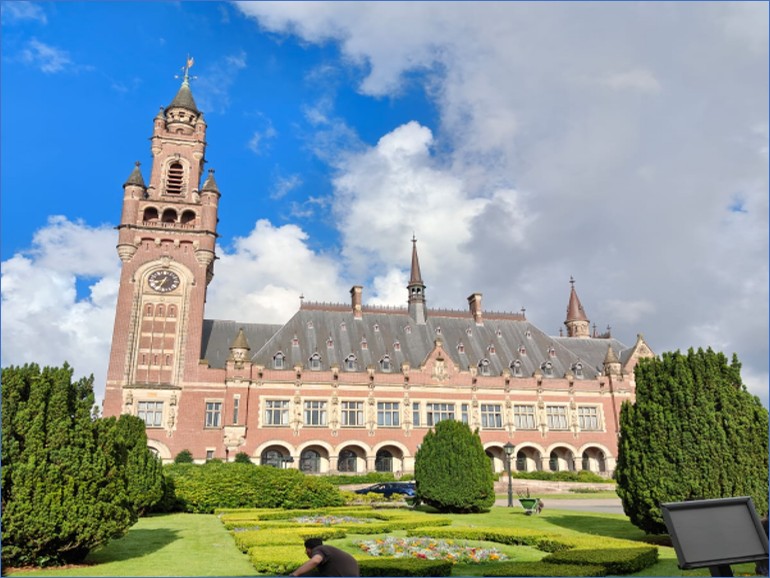
The traditional European institutional design of the International Court of Justice (Peace Palace) in The Hague visually reflects the historical Western origins of international legal structures. (Photo by the author)
In contrast, the Kosovo Specialist Chambers (KSC) feels almost like a prison and has a distinctly carceral atmosphere. That is because it is housed in the former headquarters of Europol and was repurposed as a criminal court in 2016.
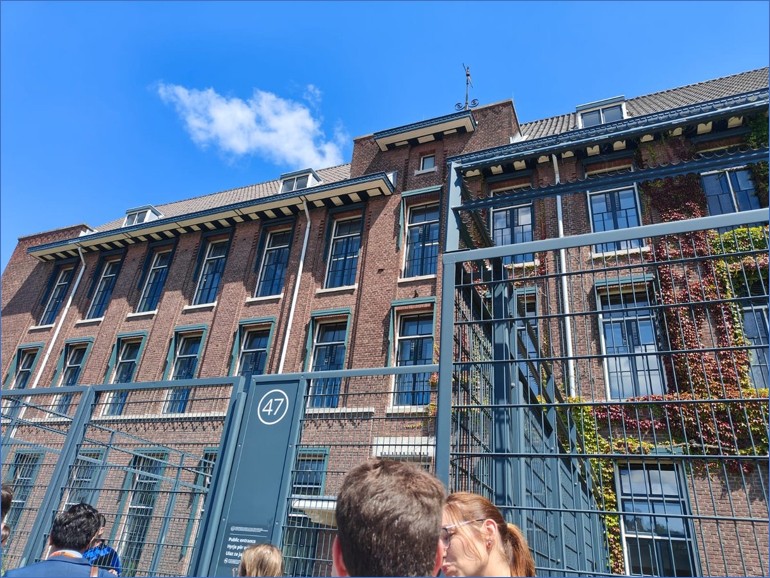
The Kosovo Specialist Chambers was formerly Europol’s headquarters and later repurposed as a criminal court. The carceral aesthetic is visible in the security fencing and gated entrance. (Photo by the author)
The ICC, on the other hand, appears visibly different. Composed of several interconnected structures dominated by glass and natural light, it projects an image of transparency and accessibility. The design appears intended to signal a break from the past and to present itself as a court closer to the people.
In practice, however, I encountered a paradox. The vast empty spaces, multiple layers of security glass, and clinical atmosphere actually create what might be described as hyper-distance. While the ICJ can feel distant because of its history, the ICC feels distant because its securitized environment gives it the character of a “glass fortress.”
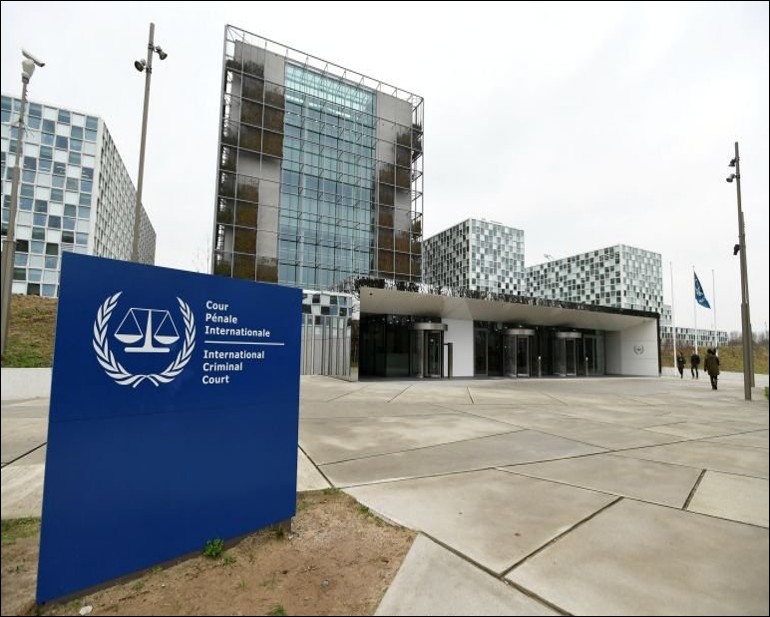
Designed to signal transparency through glass and light, the International Criminal Court instead creates a semblance of a “glass fortress”—clinical, securitized, and distant from the survivors it purports to serve. (ICC official photo)
For women from conflict zones in Africa or the Middle East, such a physical environment can feel worlds apart from their everyday reality, mirroring the procedural distance where trauma-shaped testimony is filtered through a cold, bureaucratic lens.
During my fieldwork, I also conducted archival research as a visiting researcher at the ICC Library and observed courtroom proceedings. These experiences helped me to understand the day-to-day dynamics of sexual and gender-based crime cases. Although it required patience and persistence, I was eventually able to interview a range of professionals, including ICC judges, members of the Prosecutor’s Office, defense lawyers, and civil society representatives.
The Hague therefore gave me something that legal research alone could not: an opportunity to observe the institution behind the judgments.
Inside the Machinery of Gender Justice
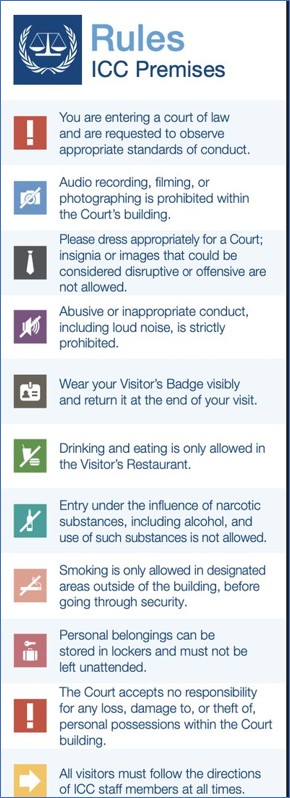
ICC premises rules displayed at the public entrance. The level of regulatory control communicated even before entry reflects the institution’s securitized character. (Photo by the author)
A key finding of this research is that the ICC is a complex international bureaucracy whose organizational structure and resource allocation influence how sexual and gender-based crimes are investigated and prosecuted. It is a multilayered organization with over 900 staff members and a substantial budget funded by member states and supplemented by voluntary contributions.
First, the prosecution of sexual and gender-based crimes is shaped by multiple institutional actors, not just judges. At the top of the organizational hierarchy sits the Assembly of States Parties (ASP) comprising all member states. The ASP elects prosecutors and judges. The Office of the Prosecutor is responsible for collecting evidence and determining charges. Judges assess and adjudicate the evidence presented by both the prosecution and defense. The Registry manages victims and witnesses under the leadership of the registrar. And finally, the Presidency, composed of three senior judges, oversees the administration of the court and represents it in external relations.
This matters because gender justice does not emerge at a single moment in a courtroom. It is produced through a chain of decisions made by different actors across the institution.
Second, resources matter. The court’s budget comes from two main sources: mandatory assessed contributions from member states and voluntary funds, such as the Trust Fund for Victims (TFV), to which nonmembers may also contribute. This resource allocation shapes investigative capacity and prosecutorial priorities, as budgetary constraints can affect the number of investigations, field presence, witness protection, and forensic capacity.
Third, charges of sexual and gender-based crime must pass through multiple “decision filters” within the ICC hierarchy. From preliminary examination and investigation to confirmation of charges and trial, different actors determine which situations and crimes receive attention, what evidence is collected, how charges are framed, and what evidence is considered sufficient to establish individual criminal responsibility. This process determines who controls investigations, evidence, and charging decisions, which in turn affects which crimes are prosecuted and which are not.

The researcher’s designated desk at the ICC Library, under a surveillance camera. On the desk are books—including Rape in Wartime; Our Bodies, Their Battlefields; and compilations of feminist civil society reporting from the Rome Statute negotiations—and a visitor badge. (Photo by the author)
These filters create multiple points of institutional gatekeeping. Sexual and gender-based crimes can therefore experience attrition before a judge delivers a verdict. What appears at the end of the process as a low conviction rate may be the cumulative effect of decisions made much earlier.
In this sense, outcomes in sexual and gender-based crime cases are stage-dependent, being institutionally negotiated rather than purely legal. The very design of the institution shapes how such crimes are prosecuted. This means that the ICC is not merely a court, and crimes are not just legal issues. Further, gender expertise is not automatically institutionalized; it requires training, leadership, and organizational commitment.
What The Hague Changed for Me
Before going to The Hague, I approached the ICC primarily as a legal institution. My questions emerged from judgments, treaties, statutory provisions, and the existing scholarship on international criminal law.
The fieldwork changed my understanding.
Standing inside these institutions, observing their spaces, watching proceedings, and speaking to people who work within and around them made the institution itself visible. I began to understand that law does not operate in isolation. It operates through people, teams, offices, budgets, routines, forms of expertise, and institutional priorities.
This realization was particularly important for my understanding of gender justice. A progressive legal framework is necessary, but it is not sufficient. A provision in the Rome Statute does not automatically lead to a gender-sensitive investigation. A charge does not automatically result in a conviction. And a victim-centered mandate does not automatically eliminate the institutional distance between an international court and the people whose experiences it is meant to address.
The Hague therefore changed not only what I was studying but also how I was studying it.
It made me more attentive to the less visible aspects of international justice: the meeting rooms, investigative teams, administrative decisions, and institutional routines that rarely appear in judgments but can profoundly influence what eventually reaches the courtroom.
Beyond the Courtroom
My dissertation, which grew out of this research, has now been submitted, and I hope to develop it further into a monograph and a series of journal articles. But I also see that the framework developed through this research has relevance beyond the ICC.
International organizations are often evaluated through their formal mandates, treaties, and final decisions. Yet institutions are also organizational spaces. Their structures and everyday practices can enable or constrain the realization of the rights and protections they formally promise.
This is why empirical research matters. It makes institutions more relatable. It allows us to move between formal rules and lived institutional practices and to triangulate what legal texts say with what people inside institutions actually experience and observe.
My experience in The Hague reminded me that international criminal justice is not shaped only by judgments and treaties. It is also shaped through discussions in meeting rooms, investigative teams, institutional routines, and everyday administrative decisions.
Understanding these less visible dimensions is essential if international institutions are to deliver on their promise of gender justice.
References
Assembly of States Parties. 2018. Report of the Court: The Registry. International Criminal Court.
Assembly of States Parties. 2025. Regulations of the Trust Fund for Victims. International Criminal Court.
International Criminal Court. 2014. Judgment Pursuant to Article 74 of the Statute: The Prosecutor v. Germain Katanga. International Criminal Court.
International Criminal Court. 2018. Non-Authoritative Summary of the Appeal Judgment: Bemba Case. International Criminal Court.
International Criminal Court. 2021. Appeals Judgments in the Ntaganda Case at the ICC. International Criminal Court.
International Criminal Court. 2022. Judgment Summary: The Prosecutor v. Dominic Ongwen. International Criminal Court.
International Criminal Court. 2024. Questions and Answers: Judgment in the Al Hassan Case. International Criminal Court.
International Criminal Tribunal for the Former Yugoslavia. n.d. Crimes of Sexual Violence. United Nations International Residual Mechanism for Criminal Tribunals.
United Nations. 1998. Rome Statute of the International Criminal Court. United Nations.