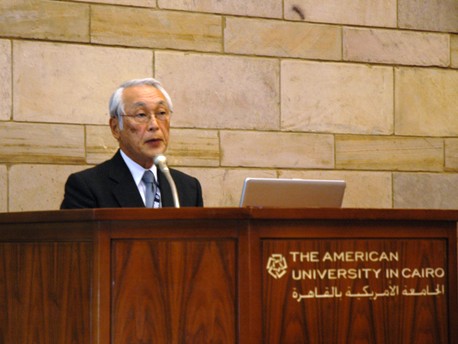
Tokyo Foundation President Akiyama at the American University in Cairo
November 30, 2012
November 30, 2012

November 28, 2012
By null
In times of financial crises, statements like “music is not a luxury, it is a need” are thrown around as a means to justify why the arts should be promoted. I hope that the following account will give such empty clichés new meaning and substance.
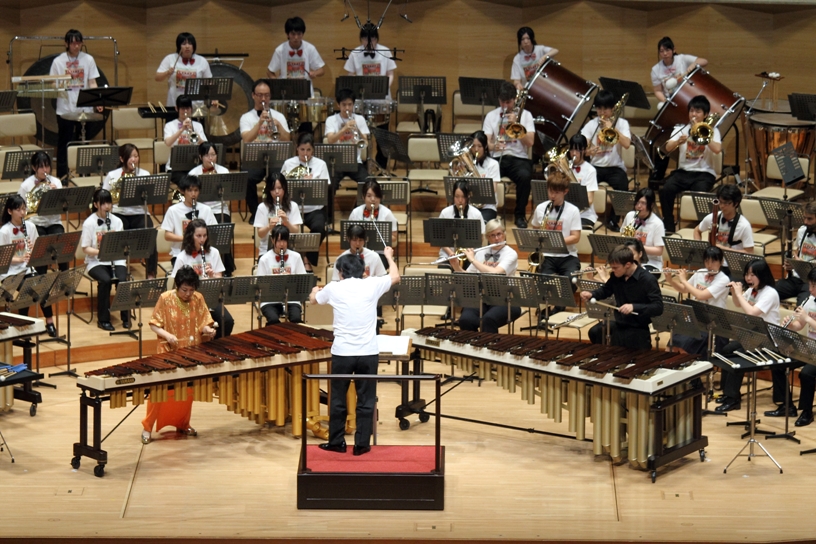
Marimba soloists: Keiko Abe and David C. Panzl
A year and a half ago it seemed that life in Japan was about to collapse. A string of terrible events led to a catastrophe of unprecedented proportions in which many people lost their lives and which caused great suffering and damage. I could never have imagined then that I would be traveling to that devastated region to teach young musicians. But so it was: in August 2012 the Tokyo Foundation gave me the opportunity to travel to Japan.
Once in Sendai and after meeting my students for the first time, I knew that there would be some obstacles to overcome. Not only was there very little time before the concert in Tokyo at the end of the week, the reserved nature of the students also presented me with a very big challenge. Fortunately I had brought along enough chocolate with me from Austria, which proved to be an ideal icebreaker during the first minutes of our acquaintance.
In order to get an idea of the level of my new 20 students, I got them in a circle for a round of practice drumming. Once in position I asked each of them to play three simple exercises that drummers need to learn and which would give me an understanding of their proficiency. The results left me somewhat perplexed, as there were only two students who were capable of playing the exercises! I couldn’t imagine how we would be able to play the difficult program assigned.
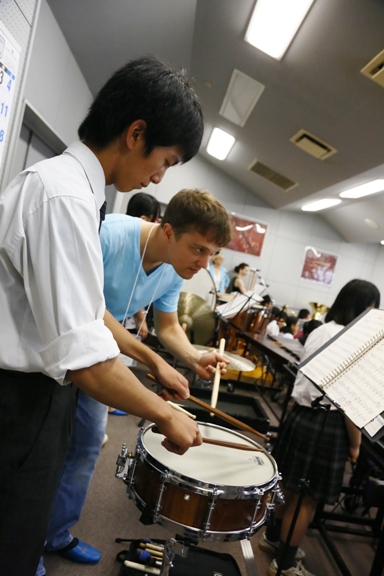 My worries turned out to be unfounded, though, when we met an hour later for the first tutti rehearsal with the full orchestra. I was very surprised to hear how well each one of the students had prepared their part and with what delight they merged into the orchestra. It seemed that the group dynamic motivated them to achieve a level of playing that was not possible at our first meeting.
This led me to change my teaching strategy, shifting the classroom lessons into orchestra rehearsals. The students seemed intimidated during the individual lessons, but now, in a group rehearsal context, they were relaxed and open. This change made it possible for me to work on what I considered most important and achieve good results within the short time frame.
The lessons took place anywhere—even in the hallways if the situation required it. It was precisely this casual teaching approach, something that Japanese students were not familiar with, that yielded the best results. When Keiko Abe, in Sendai for her double marimba concert of “Prism Rhapsody II,” attended our general rehearsal, the happiness of the students seemed complete.
On the day before the Suntory Hall concert, I and other Sylff fellows went to the region where many of the children were from to perform a mini-concert. It was quite shocking to still see the devastation, 18 months after the March 2011 disaster, and to feel the desolation that pervaded the coastal city. It was there that I realized the contrast between the laughter of my students on the previous days and the terrible images of the recent past that must have been anchored deeply in their minds.
That is exactly why music—and the arts in general—is not a luxury but an essential part of the everyday lives of people. It gives us hope, strength, courage, and joy and possesses undeniable healing powers. This is proof enough for me that the arts have infinitely more value than mere entertainment.
Our final concert at the prestigious Suntory Hall in Tokyo was not only a great success but will definitely be an event that will stay with those children throughout their lives and hopefully be an important source of motivation in their future.
This article was originally carried (in German) in the November 2012 issue of the monthly newsletter of the University of Music and Performing Arts in Vienna. Read more Together in Tohoku articles here.

David Christopher Panzl
Born to a family of musicians in Austria and started playing drums at the age of three. Attended the Konservatorium Wien (KWU), from where he received his bachelor’s degree in music (percussion). Recently received his master’s degree from the University of Music and Performing Arts, Vienna (MDW), where he learned about the Michinoku project and volunteered to participate as a member of the Sylff Chamber Ensemble. Has studied with world-renowned marimba artist Keiko Abe, who graciously accepted an invitation to participate in the project as well. Performed the solo of Abe's "Prism Rhapsody II" at the Suntory Hall concert with the composer/musician, along with a high school student from Tohoku. Now has an assistant teaching position at MDW.


November 20, 2012
Current Sylff fellow Ekaterina Frolova, a Russian-born master's student at the University for Music and Performing Arts Vienna, was named the overall Grand Prix winner at the thirteenth Osaka International Music Competition, held in October 2012.
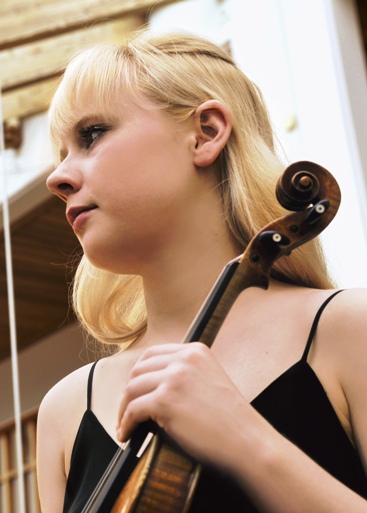
Ekaterina Frolova
She also received the Feurich-Klavier Galerie Special Award and won First Prize in the string instruments category for university students.
The Osaka International Music Competition was launched in 2000 in an effort to deepen international communication and understanding in the face of the many wars fought during the last century over racial, religious, and ideological differences.
Osaka, established some 1,500 years ago, is one of the earliest centers of Japanese culture. Just as water from Osaka Bay flows out to the Pacific Ocean and other seas around the world, organizers said they hope that young musicians participating in the Osaka competition will contribute to world peace, overcoming cultural and ethnic differences to touch the hearts of people in all countries.
"I'm extremely happy to win this international competition, for which I practiced very hard," Ekaterina said, adding, "The Sylff fellowship has been indispensable in enabling me to continue my studies at the university," where she is able to practice in an intensely competitive environment.
Our warmest congratulations to Ekaterina!
Visit Ekaterina's website at: http://www.ekaterina-frolova.com/
November 14, 2012
By 19690
Of the approximately 3.65 million students of the Japanese language outside Japan, the highest numbers are in South Korea (960,000) and China (830,000). China, though, claims more students at the tertiary level, at 530,000. How are Chinese university students learning the Japanese language and gaining an understanding of the country’s culture?
Yusuke Tanaka, a 2009 recipient of a Sylff fellowship as a student at the Waseda University Graduate School of Japanese Applied Linguistics and a research fellow at the Japan Society for the Promotion of Science, conducted a detailed study and analysis of Japanese language education at Chinese universities. He examined textbooks and curricula and interviewed both teachers and students. His research revealed features quite distinct from those seen in South Korea and Taiwan.
The following are excerpts from his report:
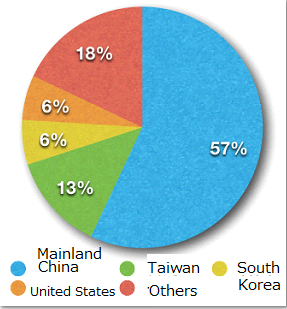
Japanese Language Students at Institutions of Higher Education in Each Country as a Percentage of the Total
Of the 1,170 universities in China, there are 466 that offer majors in the Japanese language. The figure is a threefold jump from 1999, when the Chinese government introduced a policy to expand the number of university students in the country.
The aim of this report is to examine how students of the Japanese language at Chinese institutions of higher learning—which today enjoy a growing global presence—are learning the language. Specifically, the analysis focuses on classes in jingdu (Comprehensive Japanese), the chief course taken by Japanese majors at universities in Beijing, Shanghai, and Dalian, examining and analyzing the Japanese text found in course textbooks.
The examination revealed three major characteristics. (1) The jingdu textbooks widely used today frequently quote the same passages and authors as those appearing in kokugo (Japanese language) textbooks used at schools in Japan. An extremely high percentage of Chinese students are thus exposed to the same materials as Japanese schoolchildren. (2) When creating Japanese language textbooks in China, kokugo textbooks are considered one of most reliable sources for quoting passages. (3) Inasmuch as teachers, students, textbook publishers, and researchers, as well as the instruction guidelines all concur that the aim of Japanese language instruction is be to gain an “accurate understanding of the Japanese language, Japanese culture, and the Japanese mind,” many believe it is only natural and logical for materials appearing in Japanese high school kokugo textbooks to overlap with textbooks for Chinese learners of the Japanese language.
The study revealed that the teaching materials and methods used in Japan had a definite influence on the way Japanese was taught to Chinese university students, suggesting that domestic teaching methods have a role in Japanese language education abroad. Both learners and instructors pointed to biases and deficiencies in Japanese textbooks, however; one researcher noted that the grammatical system adopted in the textbooks was designed for native speakers of Japanese, making it unsuitable for Chinese students of the language. Others voiced the need to make a clear distinction between native and foreign learners, adjusting the content and methods of Japanese language instruction accordingly to meet fundamentally contrasting needs and aims.
There was also a perceived need to be vigilant for normative elements and assumptions about universality that, by nature, are part of language instruction for native speakers. And there may be a danger in referencing textbooks that are designed for domestic use and contain—as some claim—biased content as sources for the “accurate understanding of the Japanese language, Japanese culture, and the Japanese mind.”
Nevertheless, making a mechanical distinction between Japanese language instruction for native and foreign speakers and simplistically assuming them to be isolated concerns will only hinder efforts to gain a true grasp of Japanese language teaching in China. Rather, there is a need to broaden our perspective and fully acknowledge the intertwining of the two approaches to language teaching that now exist in China. This, I believe, is an extremely important consideration in understanding the diverse and fluid nature of foreign languages and cultures and in reexamining what Japanese language education in China should seek to achieve and how it should be structured. I thus hope to conduct further research and analysis into this topic.
This study focused on an analysis of textbooks used in Japanese language instruction at Chinese universities. I would be most happy if the findings of this report—that the methods used to teach Japanese to native speakers deeply influence how the language is learned by nonnatives—would become more broadly known to Japanese language educators both in Japan and other countries.
Read the full Japanese report at: www.tkfd.or.jp/fellowship/program/news.php?id=130
November 8, 2012
Egla Martínez Salazar, one of the first winners of the Sylff Prize, has published a new, critically acclaimed book titled, Global Coloniality of Power in Guatemala. Racism, Genocide, Citizenship. 
In this critique of the geopolitics of knowledge, Martínez Salazar examines the racialized feminicide, attacks on Maya children, and other forms of state terror in Guatemala that occurred in the 1980s and 1990s with the full support of the Western colonial powers.
Drawing on a careful analysis of recently declassified state documents, thematic life histories, and compelling interviews with Maya and Mestizo men and women, Martinez Salazar, who herself was born and raised in Guatemala, shows how people resisting oppression have been pushed into the political periphery.
At the center of her book is an examination of how coloniality survives colonialism, a crucial point for understanding how contemporary hegemonic practices and ideologies—such as equality, democracy, human rights, peace, and citizenship—are deeply contested terrains, for they create nominal equality from practical social inequality.
While many in the global North continue to enjoy the benefits of such domination, millions, if not billions, in both the South and North have been persecuted, controlled, and exterminated during their struggles for a more just world.
“One of the strongest aspects of the book,” writes Walter D. Mignolo, author of The Darker Side of Western Modernity: Global Futures, Decolonial Options, is that it “shows how racism works in everyday life—in racializing proper names and clothes, entangling economic injustices, and exploiting labor. . . . Attentive to the colonial wound that she herself experienced, Martinez Salazar explains genocides and feminecides as logical consequences of coloniality, the hidden agenda of modernity.”
Purchase this book at: http://www.amazon.ca/Global-Coloniality-Power-Guatemala-Citizenship/dp/0739141228/ref=sr_1_1?ie=UTF8&qid=1344638408&sr=8-1
November 8, 2012
By 19612
This week constituted a profoundly human experience, bringing together as it did musicians of different nationalities in a very particular context.
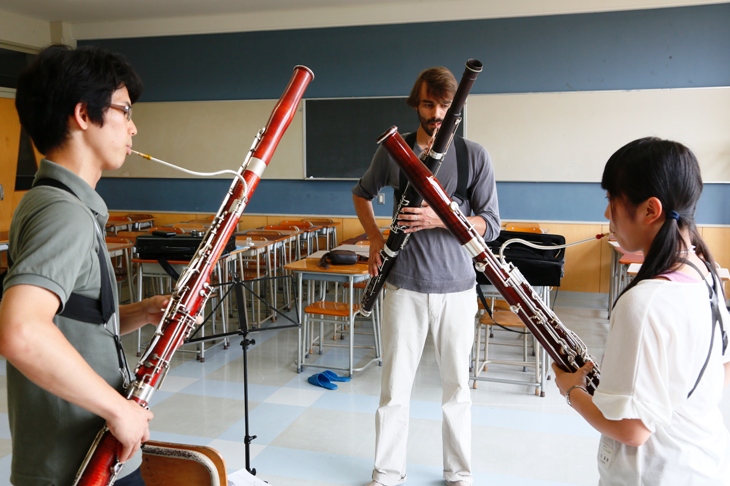 The encounter with these Japanese students was, for me, absolutely remarkable. In their way of listening, I felt and appreciated a profound respect both for us and for each other. Each musician was absolutely present, ready to give his very best and to work with determination. I was also struck by their remarkable and unusual sense of discipline. In France, we are used to orchestral rehearsals during which it is not infrequent to hear whisperings while the conductor speaks. Here, there was a wonderful silence and a capacity to respond immediately.
I loved the sincerity, the passion, the smiles, and the energy each of these young people brought to the project—despite the incredibly difficult context in which they have found themselves since March 2011. This week gave me valuable new perspectives on what now appear to be our “small problems” in France and our permanent state of dissatisfaction. It also warmed my heart to see young people who respect one another so deeply!
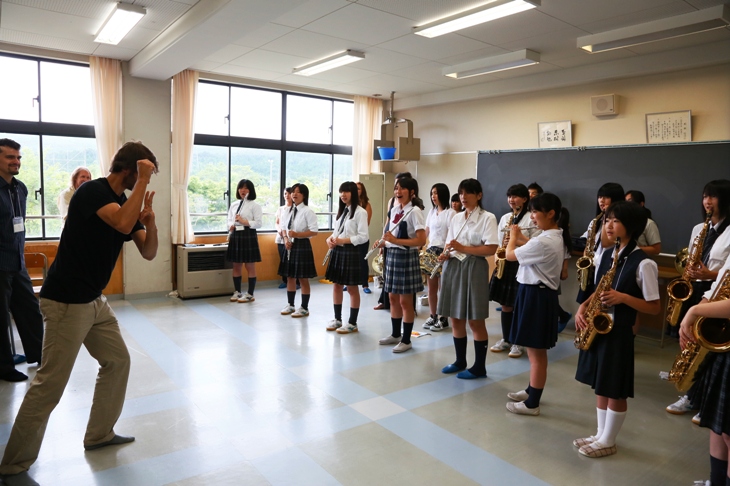
"sound painting"
I really enjoyed playing with all these musicians in the orchestra, and especially being able to work together on “sound painting.”1 A beautiful exchange…
It’s hard to describe the depth of the impression of being “re-oxygenated” from within—simply by sitting next to a person, without necessarily speaking, but just feeling how he is living and breathing fully this present moment!
Read more Together in Tohoku articles here.
1 In between orchestral rehearsals, “sound painting” workshops were held that called on musicians to improvise on the spot in response to sign language instructions from the conductor. This is a technique used in contemporary music that gives performers greater freedom of emotional expression and stimulates their imagination. Exposure to such experimental techniques was probably one of the highlights of the Michinoku project. A total of approximately 40 curious middle and high school students participated in two fun-filled and engaging workshops.
October 31, 2012
October 31, 2012
October 31, 2012
October 23, 2012
By 19673
Last April, when I first heard about the Tokyo Foundation’s project, Together in Tohoku Workshops and Concert, I was immediately interested. I had never been to Japan, and the simple thought of making the trip was most exciting. When I learned of the project’s scale, I was even more eager to participate, for such a combined artistic and humanitarian initiative resonates profoundly with my own vision of the artist’s role in society as a citizen-musician.
A year and a half ago, when I saw the tragic events experienced by the inhabitants of the Tohoku region, I felt extremely sad and helpless by the enormity of it all. I was frustrated not to be able to help and could only observe the horror unfold on my television screen. I saw a nation deploy all its energy and courage to try to save its citizens. The Sylff project in Tohoku, in which I was lucky enough to participate, provided me with an opportunity to act and contribute—at my own level—in playing a small part in rebuilding the devastated region.
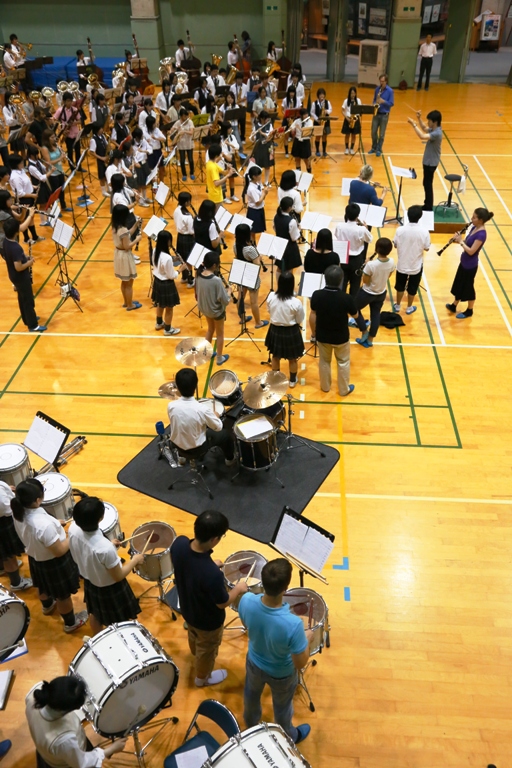 From what I observed, working with 18 saxophonists within an overall group of a hundred musicians aged 13 to 22, I felt that the orientation of the Japanese students was significantly different from that of the French. The Japanese have very good ensemble techniques and excellent orchestral practice habits. My contribution was needed in the area of individual technique. The reverse would have been true in France. This can probably be explained by the difference between the two music education systems. The students had a wonderful spirit, and showed a great thirst to learn.
At the beginning of the week, I found my group very reserved and shy. But this didn’t last long! In the end, each one showed himself to be extremely open-minded and determined. At first, we “coaches” felt hindered by our ignorance of Japanese and by the paucity of translators and interpreters, but this soon gave way, and the magic of music’s universality allowed us to give several private lessons. Personally, I found the challenge of questioning my own teaching methods and ways of communing particularly rewarding. On the last day, to my great surprise, during the small reception given after the special concert in Suntory Hall, I realized that many of the students actually spoke a little English but had not dared say a word! 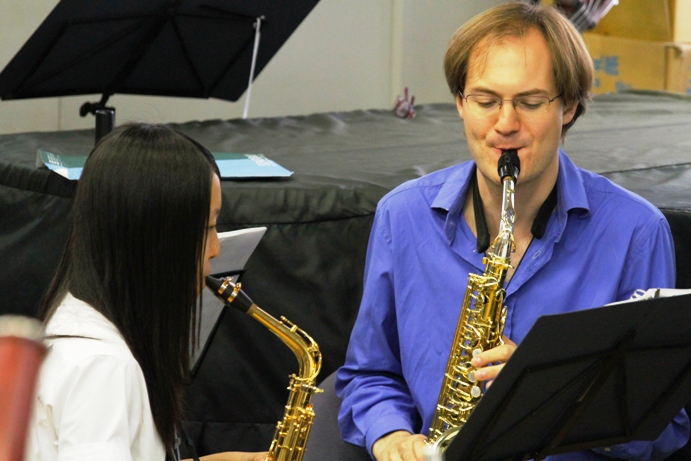
The experience of working with these young people, victims of the tragedy, was a profoundly moving and exciting one for me. Behind their apparent timidity, I met sensitive, generous, and thoughtful human beings. In fact, I discovered an entire culture during my week in Japan.
Visiting Ishinomaki was a highlight. Seeing this devastated city was a real shock. So many empty spaces in the middle of the city, formerly occupied by houses and buildings, in which grass was growing back; the numerous houses whose ground floors had been destroyed; the school whose blackened walls were destroyed by fire after being covered by the sea; and the incongruous everyday objects still dotting the landscape: They all bore testimony to the ravages of the tragedy.
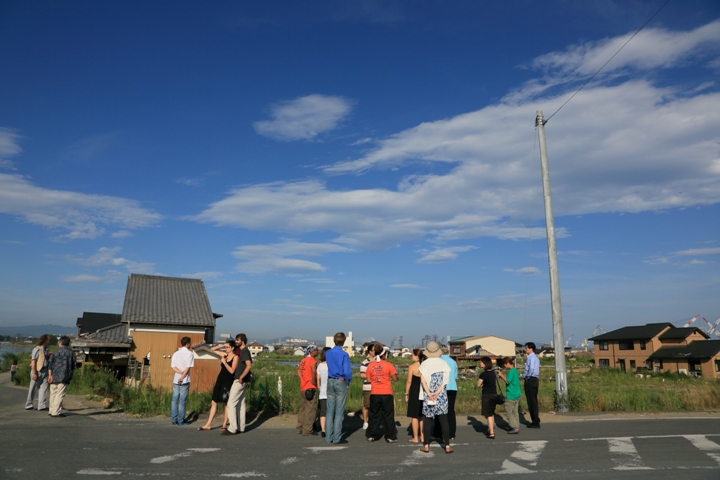 The concert we performed in this city was both sad and inspiring, coming as it did following our tour of the city by bus. We saw members of the public, often with tears in their eyes, listening to us perform in a community center which had doubtless been used as a shelter. I hope we were able to transmit our sense of hope and caring.
The week in Japan also allowed me to meet Sylff fellows from Paris, New York, and Vienna and to share an experience of living in communion with people I did not know but with whom I shared common interests. I loved meeting the Sylff coordinators—such caring people—and all the extraordinary volunteers involved, including the translators and musicians. I really hope to stay in touch with the people involved in the project.
Following our Suntory Hall concert, David Panzl and I started developing a joint chamber project which should lead to further concerts in Europe. Thanks to Facebook, we have also been able to share pictures and to stay in touch with many of the students.
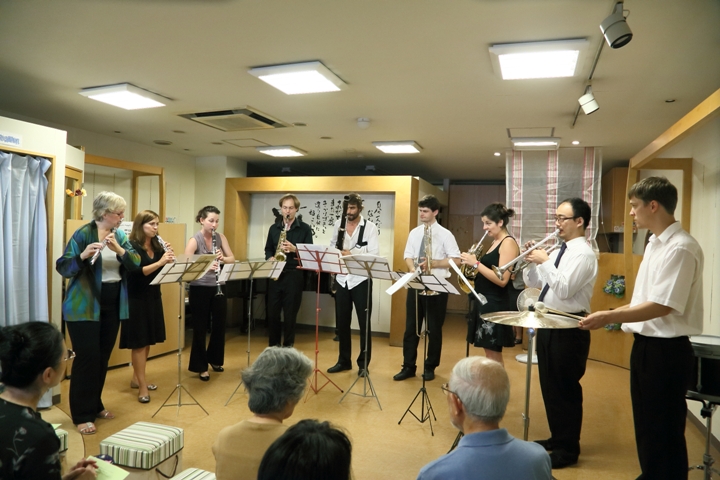
In the end, I believe I learned at least as much as the students we were there to coach. This experience has made a profound impact on me, and I think how lucky I was to be a part of it. I’d be delighted to participate in similar projects in the future! As students, we often travel—sometimes long distances—to reach teachers in academies or music courses. Here, it was the opposite, with “coaches” from different countries coming together to work with a group of students, to share know-how, and make music together. The presence of outstanding musical personalities, such as Keiko Abe, was also important. The precious moments we shared, in which the concept of distance become relative, struck me as being truly original. This collaboration between cultures will be, I hope, a precursor of future ones.
I would like to express my profound gratitude to the Sylff program, the Tokyo Foundation, the Paris Conservatoire, Juilliard, and Vienna, as well as all the many project partners.

