When the Local Association Networking Support (LANS) was launched in September 2017, the Jadavpur University Sylff Association (JU-Sylff Association) was the first to take advantage of it. In March 2018, the association organized a two-day event in Kolkata, India, inviting JU-Sylff fellows from other parts of India, as well as Britain and Ireland. This year it organized another one, as successful as the first but with more depth in contents. The following is a report on the meeting.
* * *
Our Vision for LANS 2019
JU-SYLFF began in 2003 with the vision to create an interdisciplinary research platform for students who hold the capacity to lead social change. Fifteen years on, the collective has grown to number over 40 fellows who have carried within themselves the ethos of SYLFF in their deeply diverse yet convergent projects.
In 2018, JU-SYLFF received the inaugural Local Association Networking Support (LANS) grant from the Tokyo Foundation for Policy Research. The meeting organized with this grant brought together fellows, graduated and current, along with mentors, who discussed their research and deliberated over the potential of capacity-building measures. They attempted to imagine ways in which collective goals could be achieved that may go on to address social, cultural, and environmental issues that concern us all in different ways.
It also marked the beginning of something new—the potential to create something whose impact could be greater than our individual projects and research interests. The note of enthusiasm on which LANS 2018 had ended ensured that the conversation would be carried on beyond the one-day meet. Several months of meetings and electronic communication later, the theme for LANS 2019 was centered around the idea of inclusivity, interpreted in its widest possible sense.
It became a matter of great honor for JU-SYLFF to receive the LANS grant for a second time in 2019. LANS 2019 gave us a fresh chance to create stronger networks within the SYLFF community for building an inclusive sphere of knowledge within academia and beyond. The meet was held over two days, March 14 and 15, 2019. The first day consisted of our annual visit to the Premananda Leprosy Mission Hospital as part of the Social Action Program at JU-SYLFF. The second day was assigned for capacity building through deliberation on four different areas in which the academic and professional experiences of fellows converge. The aim of creating such panels was to provide a thematic direction to our discussions on inclusivity.
JU-SYLFF LANS Meet 2019, Day One
Visit to Premananda Memorial Leprosy Hospital
As part of the JU-SYLFF Association’s Social Action Program, current and graduated fellows visited the Premananda Memorial Leprosy Hospital on March 14, 2019. The hospital is located adjacent to the Manicktola Christian cemetery in the northern part of the city and was established in the year 1986 by Reverend Premananda Sen of the Oxford Mission as a treatment center for leprosy sufferers. It is currently run by the Leprosy Mission Trust India.
As with every year, fellows gathered at the SYLFF office in the morning to set out for the day. Reaching the hospital at 11 am, the team, along with the head of staff, Mr. Mark Moloy Ambros, went around the inpatient and outpatient wings to meet everyone at the hospital. The fellows met Dr. Helen Roberts, medical superintendent of the hospital, to learn about the many positive changes that had taken place at the hospital since their previous visit. Among the new additions to the existing infrastructure of the hospital was an elevator that could accommodate stretchers; the previous could only accommodate patients who were sitting or standing. Hospital beds with side rails had also been arranged for patients who might run the risk of falling off. The hospital has also begun to visit schools and organizations by invitation for the purpose of conducting awareness campaigns on leprosy free of charge.
As the helpful staff of the hospital took us around, they introduced us to individual patients. Our exchanges with them were heartening. But the story of one patient, Jamshed, particularly inspired us.
Prior to his ailment, Jamshed worked as a bricklayer in his village, Gangarampur, in South Dinajpur. He not only sustained himself with the money that he earned but also took care of his siblings and supported their education. He was admitted to the Premananda Memorial Leprosy Hospital in 2016 with the help of Pastor Nicholas Hembrom shortly after he was diagnosed. Despite his severe ailment, Jamshed was not only determined to recover from leprosy and begin working again but was also committed to bringing the services of the Premananda Mission Leprosy Hospital and the Leprosy Mission Trust India to his hometown, where many men, women, and children similarly suffered from leprosy. The hospital has been engaged in community outreach for over two years, ever since Jamshed’s efforts began to take shape in 2016. In their many visits to Gangarampur as part of their community outreach program, the hospital has conducted extensive surveys and awareness campaigns across the village with the help of Pastor Hembrom and Jamshed to tend to the poor who suffer from leprosy. Medical treatment and supplies have been distributed for free.
In 2017 the total number of patients treated at the village was 187, whereas this year over 360 patients were treated on the hospital’s visit on March 9. The hospital envisions more frequent visits to the village, perhaps on a quarterly basis from this year onward. Jamshed has also been rehabilitated by the hospital and is currently employed as the watchman of the premises. His story and his determination to help his people are heroic and of unparalleled inspiration to all of us at JU-SYLFF.
With contributions from the JU-SYLFF family, the fellows were able to offer medical supplies, fruits, and sweets for the patients at the hospital. Along with the supplies offered, a sum of 3000 INR was donated for prosthetics. It will be of foremost interest to us in all our future visits to the hospital to continue collecting funds for prosthetics.
A special lunch was arranged for the patients. Our team was delighted to be accompanied by the doctors and staff for lunch. A popular film, Dangal, was screened in the afternoon. The team departed from the hospital in the evening after a truly inspiring day.
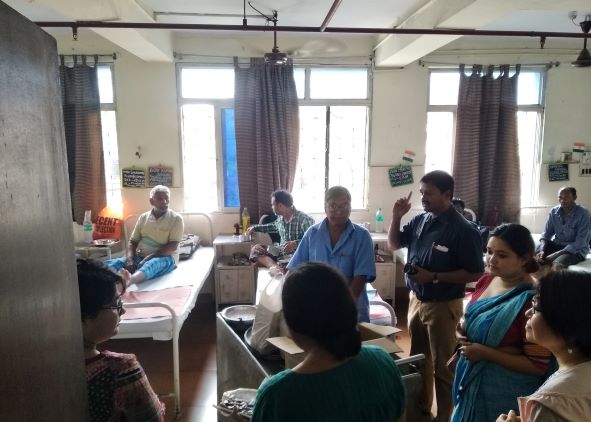
Our team interacting with patients at the Premananda Memorial Leprosy Hospital.
JU-SYLFF LANS Meet 2019, Day Two
Introspections on Inclusivity
Day two at LANS 2019 was arranged around the academic and professional experiences of fellows and the theme of inclusivity. The discussions were divided into four panels on pedagogy, environment and sustainability, gender and sexuality, and historiography. The 12th edition of the annual newsletter of JU-SYLFF, Fellows, was released.
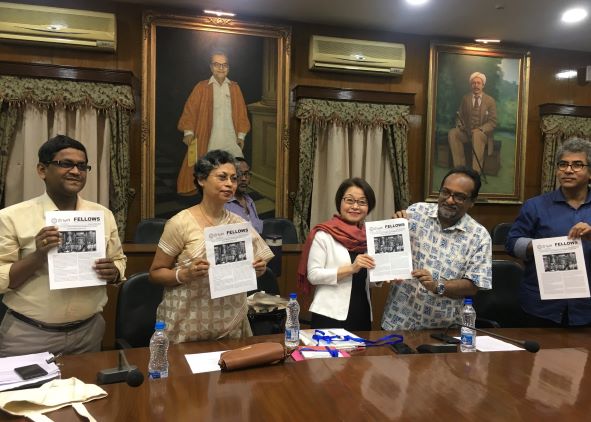
The 12th edition of the annual newsletter of JU-SYLFF, Fellows, being released.
Pedagogy
“Why is difference important?” was the question that opened the first session of LANS 2019. In order to make it interactive, the audience was divided into groups and asked to present their views. A number of varied responses were recorded. While some thought that difference is required as a marker of distinctiveness, others noted how difference is imperative to the very foundation of democracy. This process of debating and deliberating in turn became an exercise in including difference. What emerged was a holistic perception of “inclusivity” that caters to the recognition and acknowledgement of difference. Speaking on inclusivity with respect to pedagogy, Anindita Roy questioned the politics of and preference for exclusion. She emphasized the importance of linguistic diversity, showing how bi- and multilingualism can promote an inclusive pedagogic practice for children.
Gender and Sexuality
If the first session aimed to explore the measures taken for inclusivity, the second panel brought to the fore what often remains excluded in our rather clinical attempts to include. This panel was chaired by Professor Kavita Panjabi, JU-SYLFF mentor and faculty at the Department of Comparative Literature, Jadavpur University. One of our earliest SYLFF fellows and now an international expert and activist on issues of intersexuality and sport, Payoshni Mitra spoke about the lack of awareness about the multiplicity of bodies that results in discrimination against female athletes with hyperandrogenism. She suggested that inclusivity may be comprehended in several ways. It is not enough to simply bring change in policies and regulations to include nonnormative bodies; the need of the hour is to critique and problematize the “norm” itself, as it is deeply rooted in structures of oppressive power. Mitra cites the example of how those female athletes with DSD should not be seen as having a “disorder” (as this implicitly entails a negative deviation from the norm) but a “difference” of sexual development. A reframing of the term can be a simple step toward inclusivity.
In her talk on the metamorphoses of LGBTQ+ policies in the postcolonial states, Natasha Upadhyay explained how inclusivity is a dynamic and ever-evolving phenomenon. Asserting that research in gender ought to be by principle inclusive, she shed light on some of the contemporary debates on inclusive policies at the intersection of postcolonial politics and Queer International Relations.
Rimple Mehta, who was a doctoral SYLFF fellow, discussed how she had to recalibrate her research questions in order to arrive at an inclusive, and thereby more nuanced, understanding of her subject. She illustrated the problems of being strictly rooted in and single-mindedly driven by one’s own research questions, to the extent that one ends up excluding that which needs the most attention. Mehta has worked extensively with Bangladeshi women prisoners on either side of the Indo-Bangladesh border. Although initially poised on the question of violence, her research gained more ground when she realized what had been excluded: the prisoners’ stories of love and love as the truest form of resistance. Including these unheard narratives finally led her to posit these women as “resisters” of violence, not simply its victims. She thus urged researchers to be self reflexive at every point and strive for “epistemological inclusivity.”
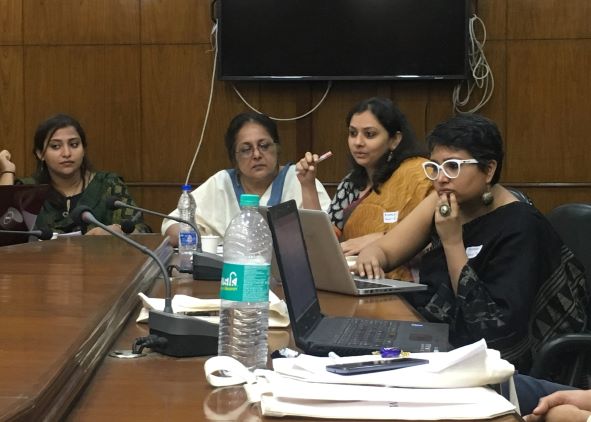
Fellows and mentors discussing questions of inclusivity.
Environment and Sustainability
This panel was chaired by Professor Joyashree Roy, founder-advisor at JU-SYLFF and Bangabandhu Chair Professor at Asian Institute of Technology, Thailand. She prefaced the session by mentioning that the thrust of the panel was threefold: to inquire how, if at all, inclusivity is operational in one’s field of work; to see who remains excluded; and to consider how one can be more inclusive with respect to environment and sustainability. The three panelists explored these concerns from their individual areas of research.
Duke Ghosh shared his concerns about the key human aspects, such as environmental health hazards, that are seemingly accounted for on paper but are excluded when infrastructural projects are eventually undertaken on the ground.
Shyamasree Dasgupta’s discussion was hinged on the need for an inclusive evaluation of forest resources so as to serve the cause of all stakeholders involved. She insisted that it is only through an inclusive evaluation of what natural resources provide that one can ensure distributional fairness and ecological sustainability. Related to this notion of the value of the natural environment is how indigenous communities continue to situate themselves at the crossroads of nature and civilization.
Extending the notion of inclusivity beyond anthropocentrism, Sudeshna Dutta spoke of adidharam. This is the principle that directs indigenous peoples to hold relations not only with fellow human beings but also with their surroundings, including the flora, fauna, and their natural habitat. According to this, inclusivity becomes a way of life—a mode of perceiving the world without hierarchies of power. However, Dutta mentions that such an inclusive approach is difficult to adopt and is only possible when one acknowledges one’s own epistemic limitations.
Historiography
The final panel of the day was chaired by Professor Abhijit Gupta, JU-SYLFF mentor and professor at the Department of English at Jadavpur University. The panel reflected on three broad areas of historiographical inquiry. Purbasha Auddy spoke about her work on nineteenth-century periodicals published in Bengal. Between 1818 and 1867 there was a profusion of newspapers and magazines, most of which were published by upper-class and upper-caste Bengalis who had access to the means of textual production. Reading between the lines of the existing bibliographical records, Auddy indicated three main lines of inquiry that her work has followed: What ideologies do they represent? What are the gender politics that are decipherable here? And out of what geographies and spaces do they emerge?
Ritajyoti Bandyopadhyay's presentation was an attempt to understand the “postcolonial passage” marked both as a temporal and paradigmatic shift in India’s history and the terrain of official recordkeeping. What, he asked, does this shift mean for the “historian’s craft”? Bandyopadhyay’s talk was peppered with personal anecdotes and recollections, which served to illustrate his point about the transition. One in particular referred to the arbitrary manner in which archival records from Bengal were divided up between West Bengal and Dhaka. He pointed out the importance and contested status of archives built and maintained by communities that engage in political or social resistance in the face of state oppression. Bandyopadhyay suggested that in the postcolonial period, when India’s archiving mechanism went into decline compared to the colonial period, these archives have made the field far richer and more diverse. This proliferation and diversification, he argued, is what makes it difficult for the historian trained in colonial historiography to engage with contemporary histories.
In her talk, Neha Chatterjee took up the question of “historical conspicuousness”—what makes a particular movement visible and why communities might opt for an idiom of protest that is integrationist. She looked at the case of the Paundra Dalits of south Bengal—dubbed by some as “not-yet-fully mature Dalits”—and argued that even though it was a member of the Paundra Dalit community who authored the first “cross-caste Dalit solidarity in Bengal,” their decision to remain outside of dominant Dalit movements is backed by an awareness of the need to assert difference. Chatterjee argued that the Paundra Dalit movement has not caught the limelight of historical narratives because of this desire to be recognized for their contributions to social causes that include participation in the Indian freedom movement and the Tebhaga movement.
The day ended with a screening of the film In the Name of Pride directed by Payoshni Mitra, who has worked extensively in the field of gender and sport in both India and the world.
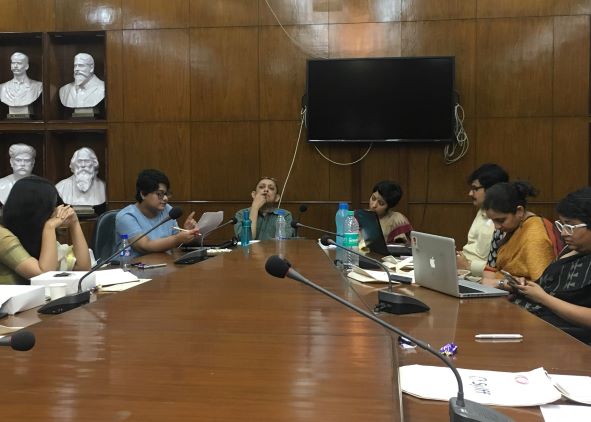
Fellows and mentors at a panel.
Looking Ahead
Over the two days at the LANS meet on March 14 and 15, 2019, fellows at JU-SYLFF found the opportunity to forge new friendships and renew old bonds that can continue to help them in creating positive change and transformation in the world around us. The active participation of our fellows and mentors culminated in the creation of a set of constructive ideas that we aim to take forward. They may be summarizes as follows:
- The creation of a blog: A virtual platform that will encourage fellows to contribute ideas and insights from their latest research and professional experiences and will make these available to a wider public readership.
- The possibility of collaborative research among fellows: A positive outcome that emerged from the structured discussions of day two was the realization of how the individual research of several fellows overlap in key areas and hold the potential of collaboration to make their respective work more inclusive and holistic. It gives us immense happiness to share that this potential is already being explored by our fellows and several discussions have begun.
- Outreach networks: Drawing on the suggestions of LANS 2018, which looked at the possibility of bringing together partners and subjects of individual research, options were explored in more detail. The possibility of creating outreach networks through grassroot conversations and multi-engagement of stakeholders are under consideration.
- Leadership meet: Building on the above recommendation, a larger leadership meet is being envisaged that may create an inclusive platform for future dialogue and engagement.
LANS 2019 ended on a note of constructive energy that has made clearer the pathway for JU-SYLFF as an inclusive platform for social change. The constant support and encouragement from the Tokyo Foundation for Policy Research has kept our endeavors brimming with sincerity and success. We share our heartfelt gratitude for all fellows, who, through the work that they carry on at their respective individual levels and by ceaseless participation at a collective level, helps JU-SYLFF grow as a family. This meet has benefited immensely from the presence and guidance of our mentors: our former project director and founder-advisor at JU-SYLFF, Professor Joyashree Roy, and current project director at JU-SYLFF, Professor Shibashis Chatterjee.
The JU-SYLFF family hopes to keep working with energy and dedication for our collective dream of living in a beautiful world that is just, inclusive, and equitable.