We Can Face this COVID-19 Pandemic Together
March 8, 2022
By 29983


February 24, 2022
By 28804
“Our target is to make India Hindu Rashtra by 2021. The Muslims and Christians don’t have any right to stay here...So they would either be converted to Hinduism or forced to run away from here."
(Rajeshwar Singh, RSS office-bearer, cited in Islam, 2020)
It was not long ago when communal harmony and religious pluralism were synonymous with India. Mahatma Gandhi united a deeply religiously diverse Indian population to fight against British rule. Gandhi, a religious Hindu, mobilized diverse Indian citizenry to an inclusive, tolerant, and religiously plural discourse which helped religious minorities affirm their faith in an inclusive India. Gandhi tried to address the ontological (in)security of religious minorities who were unsure about their security in a Hindu majority nation. The idea of Ontological security (Gidden, 1991) refers to a ‘person’s fundamental sense of safety in the world’, it includes a basic trust of other people and, it is intimately connected to emotions.
It is important to note, Gandhi was murdered on 30th January 1948 by a member of RSS (Venugopal, 2016) Nathuram Godse, who abhorred the idea of Hindu-Muslim unity. Gandhi's long-cherished idea of communal harmony was disrupted when Prime Minister Narendra Modi – a Hindu nationalist leader – rose into power in 2014. Modi moved Hindutva (also known as Hindu nationalism) from the political margins to mainstream politics. So, one can naturally ask, what is the relationship between Hindutva and Gandhi’s inclusive nationalism regarding ontological (in)security and, what different emotional atmosphere Hindutva create compare to Gandhi's interculturality. Possibly, an analysis of the emotional process inscribed in the ontological (in)security script could help to find an answer.
An ontological (in)security approach could provide an interesting insight into the emotional processes of Hindu electorates which has helped Hindutva populists leader Narendra Modi elected as the Prime minister of India and reconfirmed, despite knowing his complicity in the Godhra communal riots (The Guardian, April 7th 2020) when he was the chief minister of the Gujrat state in 2002. An ontological (in)security approach helps in understanding the emotional environment created by such extremist’s (Hindutva) ideology and its violent response against the ‘Others’. Hindutva thrives through the emotional governance (Richard, 2007) communication through emotional messages, and provides emotional security to an insecure Hindu electorate through religion and nationalism while stigmatizing Muslims and Christians. The ontological security approach considers that humans are security seekers by nature, they are always in search of stability, and security while seeking to reduce their 'fear' and 'anxiety'. In this context, 'religion' and 'nationalism' are the two most important identity-signifier (Kinnvall, 2019) which provide stability and security in times of the perceived crisis.
The aggressive rise of Hindutva in the 1980s is a crucial turning point for a secular Indian state, which is on the verge of becoming a Hindu authoritarian state where calls for genocide of Muslims (Aljazeera news, December 24, 2021) and their mob lynching is normalized. Hindutva is radically far-right, hierarchical, authoritarian, and based on the idea of Hindu supremacy. On different levels, Hindutva seeks to repress dissenting views, expunging religious pluralism and secularism from the Indian political discourse. Religious minorities in India, currently, live under the constant fear of being attacked by Hindu extremist organizations such as RSS.
The discourse of Hindutva consists of a populist narrative of nativism, nationalism, and religion. Its appeal became particularly relevant in the time of perceived economic, social and political, or psychological crisis, in which ontological insecurity arises from the attempt to put identity and autonomy in question with anxiety, insecurity and alleged dangers (Laing 1965). In this context, Hindutva leaders frequently incite Hindus by portraying Muslims as rapist and violent, setting a narrative of fear that the Muslim population will take over India in fifty years (Soz, 2016), thus, Hindus will be a minority in their own country; this appears to create ontological insecurity among Hindus who may perceive that their religious identity and autonomy is in danger, thus, they react by supporting Hindutva extremists leaders, and sometimes are complicit in violence against Muslim minorities.
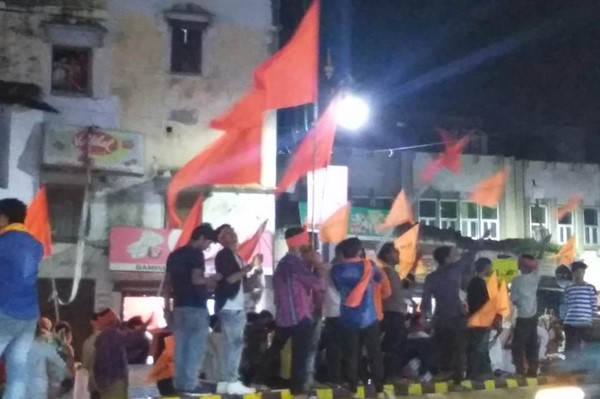
Hindutva followers with Hindutva saffron flag taking its procession in Varanasi.
The Indian case shows us how an illusion of ontological (in)security has helped Hindu extremism rise. Modi have been religiously polarizing Indian electorates; he invoked past traumas (Islamic invasion of India) and glories (fantasies of the greatness of the Ancient India and Kingdom of Rama) of a lost Hindu nation. In his recent visit to Varanasi at the Kashi Vishwanath temple, Modi invoked the greatness of the Indian (Business Standard, December 13, 2021) while underlining the atrocities perpetrated under the Muslim rulers; while laying the foundation stone for the Ram temple at Ayodhya, Modi again invoked (Indian Express, August 5, 2020) India’s eternal glory. Setting the emotional political narrative around restoring the Hindu temples in Kashi, Mathura (The Hindu, December 10, 2021) and Ayodhya are also parts of this ontological security; temples represent the symbolic superiority of the mythic spiritual glory of the ancient Hindu nation, and their fall at the hands of Muslim invaders represents national humiliation (national trauma) of Hindus. This narrative generates an atmosphere of ontological insecurity among Hindus who could vent their anger against Muslims.
It shall be noted that the Islamic invasion of India (12th to the 16th centuries) and the partition of India and Pakistan in 1947 are some big events that are projected by Hindu nationalists as a historical traumatic event in their effort to generate narratives of constant rage, fear and, anxiety among the Hindu majority, which usually results in Islamophobia and, normalization of violence against Muslims. Central to such narrative construction (Kinnvall, 2016) are the collective identity and collective emotions, such as love for the nations or hate, fear, or disgust for the strange others such as Muslims. An ontologically insecure Hindu electorate demands unquestioned loyalty to its imagined nation, to its national history, and its sacred culture. Thus, these narratives of a sacred Hindu land became the objects of the people's imaginations onto which fantasies of national unity are projected to rescue the belief in the core and stable identities (Kinnvall, 2016) which is Hindu religion and culture. The use of violence, coercion and threats are justified by Hindutva to protect their core identities; because of this, Hindutva is also referred to as a muscular nationalism (Banerjee, 2012).
The re-invention of nationhood and religion (Kinnvall, 2019) in Hindutva discourse is aimed at 'healing' several ontological insecurities by which the Hindu majority suffers. Among such fears and emotional responses of Hindutva has been manifested in the forms of; Love-jihad, Corona-jihad (Milli cornicle, April 19, 2020) UPSC-jihad (The Print, November 18, 2020) mob lynching of Muslim (BBC, September 2, 2021) and Dalits, disrupting Muslim prayers (NDTV, December 18, 2021) vandalizing Churches (November 30, 2021) and boycotting Muslims vegetable (News Click, April 13, 2020) vendors and sellers.
Gandhi tried to heal public anxiety and insecurity through his inclusive nationalism. He mobilized people to gain political freedom from British colonialism. Nevertheless, Gandhian nationalism was not narrow or exclusive but meant for the benefit of the whole of humanity. He tried to make public ontology secure through his idea of inclusive nationalism and intercultural unity. Gandhi believed in inclusive nationalism irrespective of religion, caste, and class. For Gandhi, nation was to improve the living conditions of the people (Patnaik, 2019) or to "wipe away the tears from the eyes of every Indian". Gandhi was inspired by the Hindu religious and spiritual values promoting Hindu ways of life, discipline, fasting method, and mental purity. His political actions (civil disobedience, fasting) were in line with the Hindu religious ideas of truth and non-violence.
However, Gandhi was concerned about the deep communal tension among communities (Hindu-Muslims, Dalits-Upper castes, rich-poor), thus managing such tensions and averting serious conflict was on top of his political agenda. He believed that communal violence could trigger ontological insecurities among communities and could jeopardize the freedom struggle and communal harmony among them. His religiously plural discourse helped him create an ontologically secure environment and, cementing ties with Muslims and other religious minorities and lower-caste Hindus.
By employing an inclusive intercultural approach based on mutual respect and equal regard, Gandhi stressed the fundamental unity of all religions and tolerance for different faiths. At the ontological (in)security level, these methods, and processes reduced the anxiety and fear among diverse communities, assuaged fear of religious minority from the majority, and helped create a feeling of security. His idea to establish a ‘just society’ (Jahanbegloo, 2020) was also an ontological security provider to all Indians. Contrastingly, Hindu nationalists are instilling ontological insecurity among Hindus to exclude Muslims, to establish Hindu supremacy which has paved a way for an unjust society.
From the aforementioned discussion, it shall be clear that Hindutva, by creating an atmosphere of insecurity and anxiety has made the Hindu public ontologically insecure whereas Gandhi, tried to provide ontological security to the public by building an environment of religious harmony and intercultural faith. This shows that by looking into the emotional process enacted within Hindu nationalism through the idea of ontological (in)security it is possible to outline the major differences between Gandhian inclusive nationalism and the Hindutva exclusionary discourse.
References:
Banerjee, Sikata (2012) Muscular nationalism: gender, violence and empire in India and Ireland, 1914–2004 (New York: New York University Press)
Giddens A, (1991) Modernity and Self-identity: Self and society in the late modern age. Cambridge: Polity
Islam, Shamshul (2020) RSS founders 'endorsed' Nazis: It’s well-nigh impossible for races, cultures to 'coexist', Counterview, available at https://www.counterview.net/2020/09/rss-founders-endorsed-nazis-its-well.html
Jahanbegloo, R (2020) The Mahatma as an intercultural Indian, available at https://www.thehindu.com/opinion/lead/the-mahatma-as-an-intercultural-indian/article32747352.ece
Kinnvall, Catarina (2019) Populism, ontological insecurity and Hindutva: Modi and the masculinization of Indian politics, Cambridge Review of International Affairs, DOI: 10.1080/09557571.2019.1588851
Kinnvall, Catarina (2016) Feeling Ontologically (in)secure: States, traumas and the governing of gendered space, Cooperation and Conflict, Sage publication, DOI: 10.1177/0010836716641137
Laing R. D (1965) The Divided Self: An Existential Study in Sanity and Madness, Penguin Psychology, Paperback
Patnaik, P (2019) For Gandhi, nationalism was based on understanding what was required for people to be free, available https://indianexpress.com/article/opinion/columns/mahatma-gandhi-nationalism-capitalism-marx-6054147/
Richards B. (2007) Politics as Emotional Labour. In: Emotional Governance: Politics, Media and Terror. Palgrave Macmillan, London. https://doi.org/10.1057/9780230592346_8
Soz, A. S. (2016) RSS Claims About Rapid Growth of the Muslim Population are Simply False, available at https://thewire.in/politics/rss-claims-rapid-growth-muslim-population-simply-false
Venugopal, V (2016) Nathuram Godse never left RSS, says his family, available at https://economictimes.indiatimes.com/news/politics-and-nation/nathuram-godse-never-left-rss-says-his-family/articleshow/54159375.cms?from=mdr
Web resources:
Aljazeera: India: Hindu event calling for genocide of Muslims sparks outrage, available at
BBC: Beaten and humiliated by Hindu mobs for being a Muslim in India, available at https://www.bbc.com/news/world-asia-india-58406194
Business Standard: Kashi Vishwanath Dham is testament to India's culture, history: Modi, available at https://www.business-standard.com/article/news-ani/kashi-vishwanath-dham-is-testament-to-india-s-culture-ancient-history-pm-modi-121121300642_1.html
Indian Express: Ram Mandir Bhumi Pujan: Full text of PM Narendra Modi’s speech in Ayodhya, available at https://indianexpress.com/article/india/ram-mandir-bhumi-pujan-full-text-of-pm-narendra-modis-speech-in-ayodhya/
Indian Express: Delhi: Site of proposed church ‘vandalised’ in Dwarka, religious group returns to Punjab, available at https://indianexpress.com/article/cities/delhi/delhi-dwarka-church-vandalism-ankur-narula-ministries-7648358/
The Hindu: In Parliament, BJP pitches for Krishna Temple at Mathura, available at
The Milli Chronical: OPINION: Corona-Jihad of Hindutva vs Communists of Kerala
available at https://millichronicle.com/tag/corona-jihad/
The Print: ‘UPSC jihad’ show offensive, could promote communal attitudes — govt in affidavit to SC, available at https://theprint.in/india/governance/upsc-jihad-show-offensive-could-promote-communal-attitudes-govt-in-affidavit-to-sc/547415/
NDTV: 'Must Say Bharat Mata Ki Jai': Gurgaon Muslims Trying To Offer Namaz Told, available at https://www.ndtv.com/india-news/gurgaon-namaz-row-must-say-bharat-mata-ki-jai-gurgaon-muslims-trying-to-offer-namaz-told-2657225
News Click: Muslim Vegetable Vendor Abused, Thrashed in Delhi, One Arrested, available at https://www.newsclick.in/Muslim-Vegetable-Vendor-Abused-Thrashed-Delhi-One-Arrested
The original article is published in Alice news.
https://alicenews.ces.uc.pt/index.php?lang=1&id=37275
February 15, 2022
By 27520
As part of her dissertation on “The Image of Britain in Czechoslovak Media Discourses between 1939 and 1948,” 2018 Sylff fellow Johana Kłusek—with the help of an SRA award—reconstructed a “test” discourse on the British image of Czechoslovaks based on resources at the British Library. Among her findings is that whereas Czechs admired just about all things British, the Brits did not reciprocate that interest.
* * *
The origins of thinking about the Other as “the other culture” (and only more recently “the other nation”) can be traced back to medieval times. Any travelogue or chronicle would include remarks on the Others, whether the inhabitants of a faraway country, citizens of a nearby city, or members of a different ethnic or religious group. For a long time, stereotypical images were perceived as objective categories through which one could reconstruct an ethical and aesthetic worldview of different cultures or nations (Leerssen 2016). In Europe this tendency was accelerated in the nineteenth century. The continent witnessed a rise of three phenomena: the birth of mass media, self-determination of nations, and antagonistic understanding of international relations (Hahn 2011). The combination of these factors led to a deepening of both heterostereotypes (opinions that a group holds about other groups) and autostereotypes (opinions that a group holds about itself). However, a full realization of the threat that these often dangerously ingrained mental concepts pose to intercultural and international relations emerged only as a result of World War II and the Holocaust.
Despite the fact that outright stereotypes are today less present in public discourses, they keep influencing interactions in milder forms between individuals as well as groups. People tend to generalize about various outgroups based on deep-rooted preconceptions, distorted individual experiences, and media images propagated by different power groups. By observing and analyzing the making of stereotypes in history, we can better understand how dangerous othering can be when propelled by negative sentiments as well as by positive ones. On a more general note, research focused on discourses about the Other can reveal the mechanisms through which we naturally orient ourselves in the world.
Conciliation of Conservatism and Socialism in the Czechoslovak Image of Britain
In my dissertation research I examine Czechoslovakia in the period of its major existential crisis. Britain is studied as a significant Other, onto which Czechs projected their visions and hopes as well as fears and frustrations during World War II. The image of Britain between 1939 and 1945 is prevalently appellative and corresponds with the main features of the traditional European stereotyping of the country, as described by Ian Buruma (1998). Czechs admired British conservatism, adherence to principles, rule of law, tradition, and taste, as well as their humor, friendliness, and openness to other cultures. The history of ascribing those qualities to the British is long, and the Czech discourse (created mostly by the exile community in London) does not come with any radical novelties.
The image also proves Buruma’s thesis about the utilitarian usage of Anglophilia, as continental observers tend to attach themselves to British culture when they get disappointed with old referential Others. In this way Anglophilia allowed for the liberation of Czechs from the German-Russian geopolitical captivity. Also, Churchill’s “sweat and tears” mentality provided a much-needed role model in the time of the debilitating German occupation.
Most importantly, though, the image illustrates a strong need to find a new role in the radically changing world. During the quest, Czechs were interestingly able to combine admiration for the classic conservative features of British culture (or its distorted images) with admiration for the new left-wing ideas and policies born from the war circumstances. In this way, they could easily look up to the West and the East at the same time. One can thus confidently claim that the road to the embrace of the Soviet Union (as seen in the Communist Party’s victory in the parliamentary election of 1946, followed by the communist coup d’état of February 1948) was simplified by the conciliation of highly contradictory discourses that are seemingly unrelated. Britain serves here as a polarizing projection screen.
SRA and a “Test”Discourse
To conduct the prime research briefly discussed above, I use discourse analysis of a number of Czech newspapers of the time (including Čechoslovák, Nová svoboda, and Mladé/Nové Československo). However, to interpret the data correctly and precisely, I needed to reconstruct a “test” discourse on the British image of Czechoslovaks. Sylff Research Abroad allowed me to do that and to gather relevant articles from resources of the British Library. The findings helped me to partly answer such questions as: Did the British share the affection that Czechs felt—or expressed in the media discourse—toward them? Was their relationship in any way special?
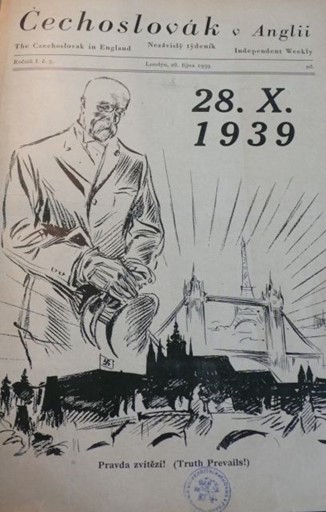
Cover of the Czechoslovak in England, featuring President Masaryk and a combined panorama of Prague, London, and Paris.
In the end, three major sets of observations were made. Firstly, the British interest in Czechoslovaks and their culture changed over time. At the beginning of the war, coverage of the cultural output of Czechs living in the country and general interest in the recent as well as older history of Czech lands was strong, but it decreased in later phases of the war. A broader wartime spirit of allyship played a significant role in these dynamics. The spirit was massively encouraged by the propaganda of both the British government and the Czechoslovak government-in-exile, primarily during the bombing of Britain in 1940 and 1941. Secondly, there is no evidence that the British were interested in Czechoslovakia disproportionally more than in other allied nations. Thus, if there was any “special relationship” between the two nations, it was rather one-sided. Thirdly, articles collected from British wartime newspapers (The Times, Manchester Guardian, and Daily Telegraph) prove that British discourse regularly used stereotypes about Czechs. The image consisted of highly idealized concepts of the country defined by a love of liberty, as a country that has always bravely striven against the threats from outside. The positive nature of those stereotypes is comparable to the nature of the stereotypes expressed at the time by Czechs when referring to the British and British culture.
Studies of opposite discourses such as the one I have just presented allows us to observe the efficiency of national propagandas, the longevity of stereotypes, and changes in their understanding as well as their usage. Their value also lies in the fact that they allow us to look at things from less obvious angles. As discourses are often influenced by many subconscious motives of many individuals, they tend to reveal tendencies of whole societies that would otherwise remain unnoticed. The Czechs’ largely blind admiration of everything British is good proof of that.
References
Hahn, H.H. 2011. Stereotypy—tożsamość—konteksty: Studia nad polską i europejską historią. Poznań: Wydawnictwo poznańskie.
Leerssen, J. 2007. “Imagology: History and Method.” In Imagology: The Cultural Construction and Literary Representation of National Characters, edited by M. Beller, and J. Leerssen, 17–32. Leiden: Brill.
